

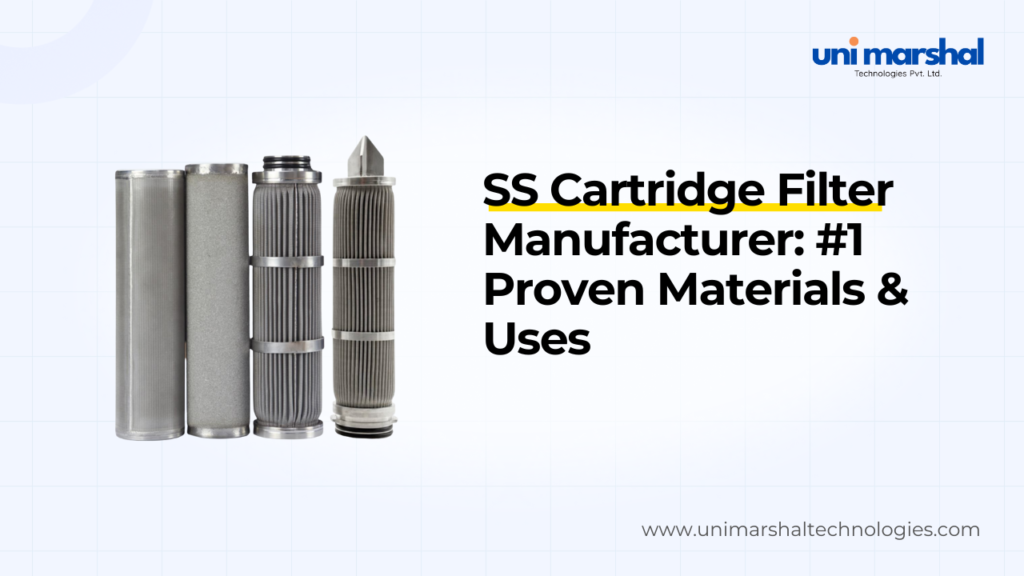
SECTION A : What Is an SS Cartridge Filter and How Does It Work?
SS Cartridge Filter Manufacturer products are widely used in industries where filtration accuracy, durability, and safety matter the most. An SS cartridge filter is a reusable filtration element made from stainless steel, designed to remove solid particles from liquids or gases.
It is commonly used where high pressure, high temperature, or corrosive fluids are involved. Unlike disposable filters, it can be cleaned and reused multiple times.
What Is an SS Cartridge Filter?
An SS cartridge filter is a cylindrical filter element made from stainless steel mesh or sintered material. It is installed inside a filter housing to trap unwanted particles.
Key points:
- Made from stainless steel material
- Reusable and washable design
- Handles harsh operating conditions
- Provides consistent filtration performance
These filters are preferred in industrial processes where reliability is critical.
SS Cartridge Filter Working Principle
The SS cartridge filter working principle is simple and efficient. Fluid flows from outside to inside, or inside to outside, depending on the design.
Here is how it works:
- Fluid enters the filter housing
- Particles larger than the micron size are trapped
- Clean fluid passes through the cartridge
- Collected contaminants remain on the surface
This process ensures clean output without interrupting flow.
Why Stainless Steel Is Used in Cartridge Filters
Stainless steel offers strength and resistance that other materials cannot match. It performs well in demanding environments.
Main advantages:
- Resistant to corrosion and chemicals
- Withstands high pressure and temperature
- Long service life
- Easy to clean and maintain
This makes stainless steel ideal for industrial filtration systems.
SS Cartridge Material Grade Overview
Choosing the right SS cartridge material grade affects performance and lifespan. Different grades suit different applications.
| Material Grade | Best For Applications | Key Benefit |
| SS 304 | Water, food, general use | Cost effective |
| SS 316 | Chemicals, oil, gas | Better corrosion resistance |
| SS 316L | Pharma, biotech | High purity and safety |
This table helps users quickly understand material selection.
Common Micron Ratings Explained
Micron rating defines the size of particles a filter can trap. Smaller micron means finer filtration.
Typical micron ranges:
- 1–5 micron: Fine filtration
- 10–25 micron: Medium filtration
- 50–100 micron: Coarse filtration
Selecting the right micron improves efficiency and protects equipment.
Where SS Cartridge Filters Are Used
These filters are trusted across many industries due to their durability.
Common uses include:
- Chemical processing plants
- Pharmaceutical manufacturing
- Food and beverage filtration
- Water treatment systems
- Oil and gas applications
Each application benefits from precise and reliable filtration.
Why Quality Manufacturing Matters
A reliable SS Cartridge Filter Manufacturer ensures consistent micron accuracy, strong welding, and proper finishing. This improves filter life and reduces operational issues.
Well-made filters deliver stable performance and long-term cost savings.
Final Understanding
SS cartridge filters offer strong, reusable, and accurate filtration. Understanding their working principle, material grades, and applications helps users choose the right solution with confidence.
This knowledge supports safer operations and better filtration outcomes.
SECTION B : Why Choose a Stainless Steel Cartridge Filter Over Other Materials?
SS Cartridge Filter Manufacturer solutions are preferred when filtration needs demand strength, accuracy, and long service life. Stainless steel cartridge filters outperform other materials in tough industrial conditions where reliability is non-negotiable.
This section explains why stainless steel is often the smarter choice compared to plastic, polypropylene, or fiber filters.
What Makes Stainless Steel Cartridge Filters Different?
Stainless steel cartridge filters are built to handle pressure, temperature, and chemical exposure without losing performance.
Key differences include:
- Strong metallic structure
- Reusable and cleanable design
- Stable filtration accuracy
- Long operational life.
These qualities make them suitable for critical applications.
Limitations of Non Metal Cartridge Filters
Other filter materials work well for light duty applications but have limits in industrial environments.
Common drawbacks:
- Plastic filters deform under heat
- Fiber filters wear out quickly
- Polypropylene struggles with chemicals
- Frequent replacements increase cost
These issues impact efficiency and safety.
Stainless Steel Cartridge Filter Benefits
The stainless steel cartridge filter benefits go beyond simple filtration. They support process stability and reduce long term expenses.
Major advantages:
- Excellent corrosion resistance
- Handles high pressure systems
- Performs well at high temperatures
- Maintains shape and micron accuracy
- Lower replacement frequency
These benefits explain why industries rely on stainless steel filters.
SS Cartridge Material Grade Matters
Choosing the right SS cartridge material grade improves performance and compatibility with the process fluid.
| Material Grade | Suitable Industries | Key Advantage |
| SS 304 | Water, food processing | Good strength and value |
| SS 316 | Chemical, oil systems | Higher corrosion resistance |
| SS 316L | Pharma, biotech | Low carbon and high purity |
This table helps users quickly match grade with application.
Performance Comparison With Other Materials
Stainless steel consistently outperforms non metal filters under demanding conditions.
| Feature | Stainless Steel | Plastic / Fiber |
| Heat resistance | High | Low |
| Chemical resistance | Excellent | Limited |
| Reusability | Multiple cycles | Mostly disposable |
| Service life | Long term | Short term |
This comparison shows why stainless steel is a long term solution.
Maintenance and Cost Efficiency
Stainless steel cartridge filters can be cleaned using backwashing or chemical cleaning. This reduces downtime and recurring costs.
Maintenance advantages:
- Easy cleaning process
- Fewer replacements
- Stable filtration over time
Although initial cost may be higher, lifetime cost remains lower.
Where Stainless Steel Filters Are the Best Choice
These filters are ideal for industries where failure is not an option.
Common applications:
- Chemical processing plants
- Pharmaceutical manufacturing
- Food and beverage filtration
- Oil and gas systems
- Water treatment facilities
Each application demands durability and precision.
Why Manufacturer Quality Matters
A trusted SS Cartridge Filter Manufacturer ensures proper material selection, accurate micron control, and strong construction. This directly impacts filter performance and safety.
Final Takeaway
Stainless steel cartridge filters offer durability, reliability, and long term value. Compared to other materials, they deliver consistent filtration, safer operations, and reduced maintenance in industrial environments.
SECTION C : SS Cartridge Filter Materials Explained: SS 304 vs SS 316 vs SS 316L
SS Cartridge Filter Manufacturer designs filtration solutions using different stainless steel grades to match industrial operating conditions. The material grade decides durability, safety, and filtration reliability.
Understanding material differences helps users select the right filter without risking corrosion, contamination, or unnecessary cost.
Why Stainless Steel Material Matters in Cartridge Filters
Material selection directly affects how a filter performs during daily operations.
Important reasons include:
- Resistance to corrosion and chemicals
- Ability to handle pressure and temperature
- Long term structural stability
- Consistent filtration accuracy
Choosing the correct grade avoids premature filter failure.
Overview of SS Cartridge Material Grades
SS cartridge filters are commonly manufactured using three grades. Each serves a different purpose.
Basic overview:
- SS 304 for general filtration needs
- SS 316 for corrosive environments
- SS 316L for hygienic and critical processes
Selecting the correct SS cartridge material grade improves safety and performance.
SS 304 Cartridge Filter Explained
SS 304 is widely used in industries with mild operating conditions.
Key characteristics:
- Good mechanical strength
- Suitable for water based applications
- Common in food processing
- Economical compared to other grades
It works best where chemical exposure is minimal.
SS 316 Cartridge Filter Explained
SS 316 contains added molybdenum, improving resistance to harsh elements.
Main advantages:
- Higher corrosion resistance
- Suitable for chemicals and solvents
- Performs well in marine environments
- Longer service life under stress
It is preferred in demanding industrial processes.
SS 316L Cartridge Filter Explained
SS 316L is a low carbon version of SS 316, designed for purity sensitive applications.
Key benefits:
- Reduced carbon content
- Lower contamination risk
- Suitable for pharmaceutical production
- Better welding stability
It supports processes where hygiene is critical.
SS 304 vs SS 316 vs SS 316L Comparison Table
| Material Grade | Corrosion Resistance | Common Uses | Relative Cost |
| SS 304 | Moderate | Water, food processing | Low |
| SS 316 | High | Chemical, oil, marine | Medium |
| SS 316L | Very high | Pharma, biotech | High |
This table gives a quick material comparison.
How to Choose the Right Material Grade
The SS 304 vs SS 316 cartridge filter choice depends on working conditions.
Selection guidelines:
- Use SS 304 for non aggressive fluids
- Use SS 316 for chemical exposure
- Use SS 316L for hygienic systems
- Match grade with temperature limits
Correct selection avoids frequent replacements.
Impact of Material Grade on Filtration Performance
Material grade affects pore stability and micron accuracy over time.
Performance benefits include:
- Stable filtration efficiency
- Reduced pressure drop
- Consistent process output
This supports reliable long term operations.
Importance of Manufacturer Expertise
An experienced SS Cartridge Filter Manufacturer ensures correct grade selection, proper fabrication, and strict quality checks. This protects users from operational risks and quality issues.
Final Understanding
SS 304, SS 316, and SS 316L serve different filtration needs. Understanding material properties helps users choose safely, improve filter life, and maintain dependable industrial filtration performance.

SECTION D : Understanding Micron Ratings in SS Cartridge Filters
SS Cartridge Filter Manufacturer designs filters with specific micron ratings to control how fine or coarse the filtration needs to be. Micron rating is one of the most important factors in filtration performance.
Understanding micron ratings helps users protect equipment, improve product quality, and avoid unnecessary pressure loss.
What Does Micron Rating Mean?
A micron is a unit of measurement used to define particle size. One micron is smaller than what the human eye can see.
Simple explanation:
- Lower micron means finer filtration
- Higher micron means larger particle capture
- Micron rating defines filtration accuracy
This helps users match filters with process needs.
Why Micron Rating Is Important in SS Cartridge Filters
Micron rating directly affects filtration results and system safety.
Key reasons it matters:
- Controls particle removal size
- Protects downstream equipment
- Maintains product purity
- Prevents blockages and damage
Incorrect micron selection can reduce system efficiency.
SS Cartridge Filter Micron Rating Explained
The SS cartridge filter micron rating indicates the smallest particle the filter can retain consistently. Stainless steel filters maintain this rating even under pressure.
Important characteristics:
- Stable pore structure
- Consistent performance over time
- Suitable for repeated cleaning
- Reliable filtration accuracy
This makes SS cartridge filters ideal for industrial use.
Common Micron Ranges and Their Uses
Different industries require different micron levels.
| Micron Range | Filtration Type | Typical Applications |
| 1–5 micron | Fine filtration | Pharma, chemicals |
| 10–25 micron | Medium filtration | Food, beverage |
| 50–100 micron | Coarse filtration | Water, pre filtration |
This table simplifies micron selection.
How Micron Rating Affects Flow Rate
Lower micron filters trap smaller particles but may reduce flow speed.
Key points:
- Finer filtration increases pressure drop
- Coarser filtration allows higher flow
- Balanced selection improves performance
Proper micron choice avoids system stress.
Role of SS Cartridge Material Grade in Micron Stability
The SS cartridge material grade helps maintain consistent micron size during operation.
Material advantages include:
- Strong pore structure
- Resistance to deformation
- Stable filtration under pressure
This ensures long term filtration reliability.
How to Choose the Right Micron Rating
Selecting the right micron rating depends on process requirements.
Selection guidelines:
- Identify particle size to remove
- Check system pressure limits
- Consider fluid type and temperature
- Balance flow rate and cleanliness
These steps help users make informed decisions.
Why Manufacturer Accuracy Matters
A reliable SS Cartridge Filter Manufacturer ensures accurate micron ratings through precision manufacturing and quality testing. This protects processes from contamination and performance issues.
Practical Benefits of Correct Micron Selection
Correct micron selection delivers measurable advantages.
User benefits:
- Improved product quality
- Reduced maintenance frequency
- Longer equipment life
- Stable process performance
Final Understanding
Micron ratings define how well SS cartridge filters perform. Understanding their role helps users select effective filtration, maintain system efficiency, and achieve consistent industrial results.
SECTION E : How to Select the Right Micron Size for Your Application
SS Cartridge Filter Manufacturer designs filters with different micron sizes to match specific industrial needs. Choosing the correct micron size is essential for clean output, smooth flow, and equipment protection.
A wrong micron choice can cause pressure loss, poor filtration, or frequent maintenance. This guide explains the selection process in a simple way.
What Micron Size Means in Filtration
Micron size refers to the particle size a filter can trap. One micron is very small and not visible to the human eye.
Basic understanding:
- Smaller micron means finer filtration
- Larger micron allows bigger particles to pass
- Micron size controls cleanliness level
This directly impacts filtration results.
Why Micron Selection Is Application Dependent
Every process has different contamination levels and flow needs. There is no single micron size that fits all.
Key factors involved:
- Type of fluid or gas
- Particle size present
- Required cleanliness level
- System pressure limits
Ignoring these factors can reduce efficiency.
How to Choose Micron Rating for Filter
The process of how to choose micron rating for filter starts by identifying what needs to be removed.
Simple steps:
- Identify contaminants in the fluid
- Determine acceptable particle size
- Check flow rate requirements
- Review system pressure tolerance
This approach ensures balanced filtration.
Common Micron Sizes and Their Applications
Different industries rely on specific micron ranges for best results.
| Micron Size Range | Filtration Level | Common Applications |
| 1–5 micron | Fine filtration | Pharma, chemicals |
| 10–25 micron | Medium filtration | Food, beverages |
| 50–100 micron | Coarse filtration | Water treatment |
This table helps users quickly match needs.
Impact of Micron Size on Flow Rate
Micron size affects how easily fluid passes through the filter.
Important points:
- Smaller micron increases resistance
- Larger micron improves flow speed
- Balanced selection avoids pressure drop
Proper selection keeps systems stable.
Role of SS Cartridge Material Grade in Micron Selection
The SS cartridge material grade ensures micron stability during operation.
Material benefits include:
- Strong pore structure
- Resistance to deformation
- Consistent filtration accuracy
This helps maintain performance after repeated cleaning.
Mistakes to Avoid When Selecting Micron Size
Many filtration problems come from poor micron selection.
Common mistakes:
- Choosing too fine without need
- Ignoring pressure limitations
- Not considering fluid viscosity
- Selecting based only on cost
Avoiding these mistakes improves system life.
How Industry Type Influences Micron Choice
Each industry has unique filtration expectations.
Examples:
- Pharma requires fine micron control
- Food processing balances flow and safety
- Water treatment uses coarse pre filtration
- Chemical plants need corrosion resistant accuracy
Application clarity improves selection accuracy.
Why Manufacturer Guidance Matters
An experienced SS Cartridge Filter Manufacturer provides technical insight, testing support, and correct micron recommendations. This reduces risk and ensures reliable filtration performance.
Final Understanding
Selecting the right micron size is a balance between cleanliness, flow, and system safety. Understanding application needs and material stability helps users achieve efficient, long lasting filtration results.
SECTION F : Common Industrial Applications of SS Cartridge Filters
SS Cartridge Filter Manufacturer designs filtration solutions that serve a wide range of industrial processes. SS cartridge filters are trusted because they offer strength, accuracy, and long service life.
These filters perform well in harsh environments where pressure, temperature, and chemical exposure are common.
Why Industries Prefer SS Cartridge Filters
Industries choose stainless steel cartridge filters for consistent and reliable filtration.
Key reasons include:
- High mechanical strength
- Reusable and washable design
- Stable micron accuracy
- Resistance to corrosion and heat
These features support continuous operations.
Chemical and Petrochemical Industry
Chemical processes demand precise filtration to protect equipment and maintain product quality.
Common uses:
- Solvent filtration
- Acid and alkali processing
- Catalyst recovery
- Process fluid clarification
SS cartridge filters handle aggressive chemicals safely.
Pharmaceutical and Biotechnology Industry
Pharmaceutical applications require strict hygiene and contamination control.
Typical applications:
- Active ingredient filtration
- Process water purification
- Sterile filtration support
- Intermediate product filtration
Material purity is essential in these environments.
Food and Beverage Industry
Filtration in food processing focuses on safety and taste consistency.
Common uses include:
- Beverage clarification
- Edible oil filtration
- Syrup and sugar processing
- Ingredient filtration
Filters must meet hygiene and cleaning standards.
Water Treatment and Wastewater Industry
Water systems rely on durable filters for long term performance.
Applications include:
- Pre filtration systems
- Industrial water treatment
- Cooling water filtration
- Wastewater solids removal
Stainless steel filters withstand continuous flow.
Oil and Gas Industry
Oil and gas operations involve high pressure and abrasive particles.
Typical uses:
- Fuel filtration
- Lubrication oil cleaning
- Hydraulic fluid filtration
- Pipeline protection
Durability is critical in this sector.
Power Generation and Energy Sector
Power plants require stable filtration for system reliability.
Applications include:
- Boiler feed water filtration
- Cooling system protection
- Turbine oil filtration
- Process fluid purification
Reliable filtration prevents downtime.
SS Cartridge Material Grade by Industry
The SS cartridge material grade should match application demands.
| Industry | Recommended Grade | Key Reason |
| Chemical | SS 316 | High corrosion resistance |
| Pharma | SS 316L | Hygiene and purity |
| Food | SS 304 | Cost effective safety |
| Water | SS 304 | Long term durability |
This table helps users match material with use.
Understanding SS Cartridge Filter Applications
The term SS cartridge filter applications covers processes where precision and durability matter. These filters adapt to different industries with consistent performance.
Importance of Manufacturer Expertise
A reliable SS Cartridge Filter Manufacturer ensures correct design, proper material selection, and accurate micron control. This supports safe and efficient filtration across industries.
Final Understanding
SS cartridge filters serve critical roles in chemical, pharma, food, water, oil, and energy sectors. Their strength and reusability make them ideal for demanding industrial filtration needs.

SECTION G : Key Quality Standards Followed by SS Cartridge Filter Manufacturers
SS Cartridge Filter Manufacturer follows strict quality standards to ensure filtration safety, accuracy, and long term performance. These standards protect industrial processes from contamination, pressure failure, and inconsistent filtration.
Understanding these quality checks helps buyers select reliable filtration solutions with confidence.
Why Quality Standards Matter in SS Cartridge Filters
Quality standards ensure filters perform as expected under real operating conditions.
Key reasons include:
- Consistent micron accuracy
- Safe operation under pressure
- Reliable material strength
- Long service life
Without standards, filtration risks increase.
Material Inspection and Grade Verification
Material quality is the foundation of filter performance. Manufacturers verify raw material before production.
Common checks include:
- Stainless steel grade confirmation
- Chemical composition testing
- Surface finish inspection
- Traceability records
Correct SS cartridge material grade ensures durability and compatibility.
Design and Dimensional Accuracy
Filter design must match housing specifications to prevent leakage or bypass.
Quality checks include:
- Accurate length and diameter
- End cap and fitting alignment
- Uniform pore structure
- Secure sealing design
Precision improves filtration reliability.
Micron Rating Accuracy Testing
Micron consistency is critical for process safety and equipment protection.
Testing methods include:
- Bubble point testing
- Flow rate verification
- Pressure drop evaluation
- Visual pore inspection
These steps confirm filtration performance.
Welding and Construction Quality
Welding quality affects filter strength and leakage prevention.
Manufacturers inspect:
- Weld strength and uniformity
- Absence of cracks or gaps
- Structural stability under pressure
- Smooth internal surfaces
Proper welding improves filter lifespan.
Cleaning and Surface Finishing Standards
Surface finish impacts hygiene and cleaning efficiency.
Quality standards focus on:
- Smooth, non reactive surfaces
- Easy contaminant removal
- Reduced bacterial retention
- Improved reusability
This is vital for sensitive industries.
Performance and Pressure Testing
Filters must withstand operating pressure without deformation.
Testing includes:
- Pressure resistance checks
- Flow consistency under load
- Repeated cleaning durability
- Structural integrity testing
These tests confirm real world performance.
Documentation and Compliance Control
Proper documentation ensures traceability and accountability.
Common records include:
- Material test certificates
- Dimensional inspection reports
- Performance test results
- Batch identification details
This supports quality assurance.
Overview of Manufacturing Quality Focus Areas
| Quality Area | Purpose | User Benefit |
| Material inspection | Grade verification | Long filter life |
| Micron testing | Filtration accuracy | Process safety |
| Welding checks | Structural strength | Leak free operation |
| Pressure testing | Performance validation | Reliable filtration |
Understanding SS Cartridge Filter Manufacturing Standards
The SS cartridge filter manufacturing standards ensure filters meet industrial expectations for safety, durability, and performance across applications.
Why Manufacturer Experience Matters
An experienced SS Cartridge Filter Manufacturer applies consistent quality checks, skilled workmanship, and process control. This reduces risk and ensures dependable filtration results.
Final Understanding
Quality standards define filter reliability. From material inspection to pressure testing, these practices ensure SS cartridge filters deliver consistent, safe, and long lasting filtration performance.
SECTION H : Factors to Consider When Choosing an SS Cartridge Filter Manufacturer
SS Cartridge Filter Manufacturer plays a critical role in ensuring industrial filtration reliability. Choosing the right manufacturer ensures quality, durability, and consistent performance in all applications.
Understanding what to evaluate helps buyers avoid low-quality products and operational risks.
Why Manufacturer Selection Is Important
The right manufacturer guarantees filters meet industry standards, maintain micron accuracy, and use proper materials.
Key reasons:
- Consistent product quality
- Reliable filtration performance
- Reduced maintenance costs
- Compliance with safety standards
Choosing carefully saves time and money.
Material Quality and Grade Verification
Material is the foundation of filter performance. Manufacturers should confirm the SS cartridge material grade before production.
Checks include:
- Stainless steel grade confirmation
- Chemical composition testing
- Surface finish and integrity
- Traceability of material source
High-grade materials ensure long-term durability.
Manufacturing Capabilities and Technology
Advanced manufacturing processes improve precision and consistency.
Factors to review:
- CNC machining for precise dimensions
- Automated welding for uniform strength
- Pore size consistency checks
- Ability to customize filter designs
This guarantees reliable and accurate filters.
Quality Standards and Testing Procedures
Quality standards ensure filters perform under real operating conditions.
Essential checks:
- Micron accuracy testing
- Pressure and flow testing
- Structural integrity evaluation
- Welding and finishing inspections
This ensures safe and long-lasting performance.
Experience and Industry Expertise
An experienced manufacturer understands industry requirements and process challenges.
Indicators of expertise:
- Years of manufacturing experience
- Knowledge of industrial applications
- Technical support availability
- Proven track record with clients
Experience reduces operational risk.
Customer Support and Service
Support affects maintenance, troubleshooting, and replacements.
Important aspects:
- Technical guidance for installation
- Quick response to issues
- After-sales support
- Product documentation and manuals
Reliable support improves overall satisfaction.
How to Choose SS Cartridge Filter Manufacturer
The process of how to choose SS cartridge filter manufacturer focuses on evaluating quality, experience, and service.
Steps:
- Review certifications and standards
- Verify production capabilities
- Check material quality and testing
- Assess customer references
These steps ensure a trustworthy partner.
Comparison Table: Factors to Consider
| Factor | What to Check | Benefit to User |
| Material Grade | SS 304, 316, 316L | Long filter life |
| Manufacturing | CNC, welding, customization | Accurate filters |
| Quality Standards | Micron, pressure, flow | Safe operations |
| Experience | Industry knowledge | Reliable solutions |
| Support | Technical guidance, response | Easy maintenance |
Final Understanding
Selecting the right SS Cartridge Filter Manufacturer ensures filters perform reliably, last longer, and meet process requirements. Careful evaluation of materials, standards, and support guarantees safe and efficient filtration.
SECTION I : Frequently Asked Questions About SS Cartridge Filters
SS Cartridge Filter Manufacturer provides a range of filtration solutions designed for durability, precision, and industrial reliability. Understanding common queries helps users make informed choices.
These SS cartridge filter FAQs address the most frequent concerns about materials, performance, and maintenance.
What Is an SS Cartridge Filter?
An SS cartridge filter is a cylindrical filter element made of stainless steel. It removes contaminants from liquids or gases efficiently.
Key points:
- Made from SS 304, 316, or 316L
- Reusable and washable
- Suitable for high pressure and temperature
- Maintains consistent micron accuracy
What Are the Advantages of Stainless Steel Filters?
Stainless steel filters offer superior strength and longevity compared to other materials.
Advantages include:
- Corrosion and chemical resistance
- High mechanical strength
- Reusable and easy to clean
- Stable filtration performance
How Long Do SS Cartridge Filters Last?
Filter lifespan depends on material grade, operating conditions, and maintenance.
Factors affecting durability:
- Proper cleaning and backwashing
- Using correct SS cartridge material grade
- Maintaining recommended flow rates
- Avoiding excessive pressure and temperature
What Micron Sizes Are Available?
Micron size determines particle retention.
Typical options:
- 1–5 micron: fine filtration
- 10–25 micron: medium filtration
- 50–100 micron: coarse filtration
Choosing the correct size ensures efficient filtration and protects equipment.
Can SS Cartridge Filters Be Reused?
Yes, they are designed for multiple cycles.
Reusability benefits:
- Reduces replacement costs
- Environmentally friendly
- Maintains stable filtration after cleaning
- Suitable for repeated industrial processes
Where Are SS Cartridge Filtration Commonly Used?
Applications span multiple industries.
Common uses:
- Chemical and pharmaceutical processing
- Food and beverage production
- Water and wastewater treatment
- Oil, gas, and power plants
How Do I Choose a Reliable Manufacturer?
Selecting the right supplier ensures filter quality.
Considerations:
- Material verification
- Micron rating accuracy
- Quality standards and testing
- Customer support and technical guidance
Quick Reference Table: SS Cartridge Filter FAQs
| Question | Key Point | User Benefit |
| What is it? | Cylindrical stainless steel filter | Reliable particle removal |
| Material grades | SS 304, 316, 316L | Matches process requirements |
| Micron sizes | 1–100 micron | Controls filtration accuracy |
| Reusable? | Yes, washable | Cost and maintenance efficiency |
| Applications | Pharma, chemical, water, oil | Versatile industrial use |
Final Understanding
These SS cartridge filtration FAQs clarify common concerns. Partnering with a trusted SS Cartridge Filter Manufacturer ensures the right material, micron rating, and quality standards for safe, efficient, and durable filtration solutions.
FREQUENTLY ASKED QUESTIONS
Other Investors Are Exploring
SS cartridge filter manufacturer || stainless steel cartridge filter benefits || SS cartridge filter micron rating || Industrial SS Filter Cartridges || SS 304 vs SS 316 cartridge filter || stainless steel filtration systems || reusable stainless steel filters || micron sizes for cartridge filters || stainless steel filter material grades || how to choose SS cartridge filter