

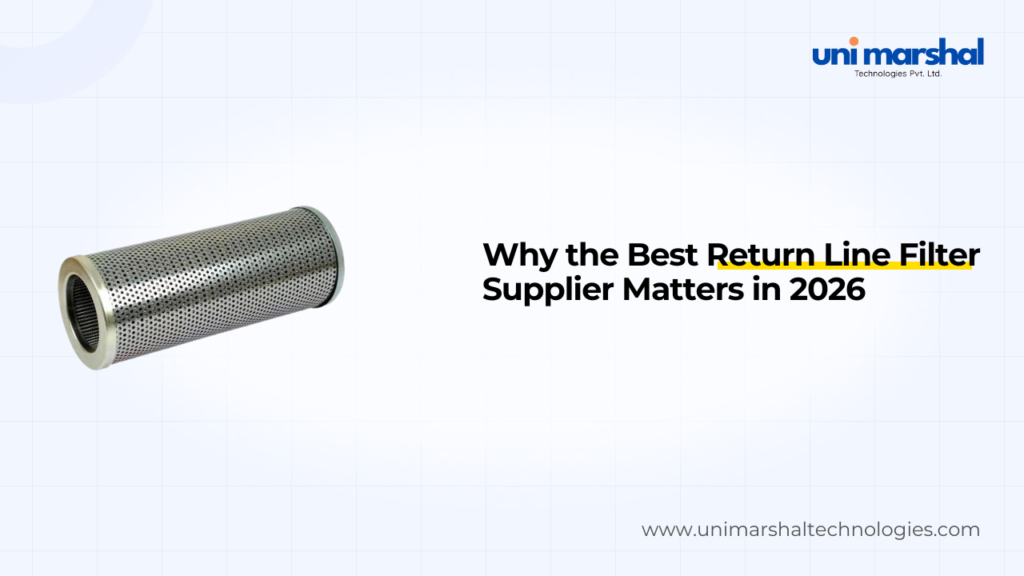
SECTION A : What Is a Return Line Filter and Why Is It Critical in Hydraulic Systems?
A Return Line Filter Supplier plays a key role in keeping hydraulic systems clean, efficient, and reliable by ensuring proper filtration before oil returns to the reservoir.
A return line filter is installed in the hydraulic return line. Its main job is to remove contaminants from oil before reuse.
Dirty oil is one of the biggest reasons for hydraulic failure. Even small particles can damage critical components over time.
What Is a Return Line Filter?
A return line filter cleans oil after it circulates through the system. It captures contamination generated during operation.
It works continuously while the system is running. This makes it one of the most effective filtration points.
Key characteristics:
- Installed on the return path to the tank
- Filters oil before it mixes with clean reservoir oil
- Protects pumps, valves, and actuators
Why Return Line Filtration Is Important
During normal operation, hydraulic systems generate particles. These come from wear, heat, and external contamination.
Without proper filtration:
- Contaminants circulate again
- Component wear increases
- Oil life reduces quickly
Using a hydraulic return line filter helps control contamination at the right stage.
How a Return Line Filter Protects the System
Return line filtration works where contamination is highest. This improves overall system cleanliness.
Main protection benefits:
- Reduces wear on expensive components
- Prevents clogging of valves
- Maintains stable system pressure
- Extends oil replacement intervals
Key Problems It Helps Prevent
A properly selected return line filter helps avoid common issues.
These include:
- Premature pump failure
- Valve sticking and leakage
- Increased downtime
- Unplanned maintenance costs
Where Return Line Filters Fit in the System
The filter sits between system components and the tank. This location allows full-flow filtration under normal conditions.
| System Area | What the Filter Does |
| After actuators | Captures wear particles |
| Before reservoir | Keeps stored oil clean |
| Continuous operation | Filters oil every cycle |
What Makes Return Line Filters Different
Return line filters handle full system flow. They are designed for low pressure drop.
Key design points:
- High dirt-holding capacity
- Durable housing materials
- Easy element replacement
- Compatibility with system flow rates
Why Supplier Quality Matters
Not all filters perform the same way. Design accuracy directly affects filtration results.
A reliable Return Line Filter Supplier ensures:
- Correct micron ratings
- Consistent build quality
- Tested filtration performance
- Application-specific guidance
Poor-quality filters may restrict flow or bypass contaminants.
When Return Line Filters Are Most Critical
These filters are essential in:
- Heavy machinery
- Industrial presses
- Construction equipment
- Manufacturing hydraulic systems
Any system with continuous operation benefits from return line filtration.
How Users Benefit from Proper Return Line Filtration
Clear advantages include:
- Longer component life
- Reduced maintenance frequency
- Stable system performance
- Lower operating costs
Understanding the role of a return line filter helps users make better system decisions and avoid preventable failures.
SECTION B : How the Best Return Line Filter Supplier Improves Hydraulic System Life
A Return Line Filter Supplier plays a direct role in protecting hydraulic components by controlling contamination and ensuring consistent oil cleanliness throughout daily system operation.
Hydraulic systems depend on clean oil. Even minor contamination can slowly damage internal parts.
Choosing the right supplier is not about branding. It is about engineering accuracy, material quality, and system understanding.
How Supplier Expertise Impacts System Reliability
An experienced supplier understands real operating conditions. This knowledge helps prevent common filtration mistakes.
A knowledgeable supplier focuses on:
- Correct flow rate matching
- Proper micron rating selection
- Stable pressure performance
- Long-term filter consistency
These factors directly affect component wear.
Filtration Accuracy Makes the Difference
Poor filtration allows harmful particles to circulate. This leads to repeated surface damage.
High-quality filtration helps:
- Reduce internal friction
- Maintain smooth valve movement
- Protect seals from abrasion
- Minimize internal leakage
This directly supports hydraulic system life over time.
Role of Consistent Manufacturing Quality
Inconsistent filters cause unpredictable results. Quality variation often leads to pressure drop issues.
A reliable supplier ensures:
- Uniform filter media structure
- Tested housing strength
- Reliable sealing surfaces
- Stable filtration performance
Consistency reduces unexpected system stress.
Why Proper Application Support Matters
Every hydraulic system is different. Wrong filter selection can shorten component life.
Good suppliers help with:
- Application-specific recommendations
- Load and duty cycle understanding
- Oil type compatibility
- Installation position guidance
This prevents mismatch-related failures.
How Contamination Control Extends Equipment Life
Most system failures begin with dirty oil. Contaminants accelerate metal wear.
Effective return line filtration helps:
- Capture wear particles early
- Prevent re-circulation of debris
- Maintain oil cleanliness levels
- Reduce heat generated by friction
Supplier Value Beyond the Product
A strong supplier relationship adds operational value. It reduces trial-and-error decisions.
Key value areas include:
- Technical documentation clarity
- Stable product availability
- Repeatable quality standards
- Long-term filtration planning
Comparison of Supplier Impact on System Performance
| Supplier Focus Area | Impact on Hydraulic System |
| Filtration accuracy | Reduced component wear |
| Material quality | Improved durability |
| Application knowledge | Correct filter selection |
| Manufacturing consistency | Stable system pressure |
| Technical guidance | Fewer installation errors |
Why Long-Term Thinking Matters in 2026
Modern hydraulic systems run longer hours. They operate under higher loads.
Filters must support:
- Extended service intervals
- Stable performance under heat
- High contamination loads
- Predictable pressure behavior
A capable supplier designs for these realities.
Real Benefits Users Experience Over Time
Users see improvements without system redesign.
Common outcomes include:
- Lower maintenance frequency
- Fewer breakdown incidents
- Stable system response
- Better oil condition management
These benefits compound year after year.
Why Supplier Choice Is a Technical Decision
Selecting a supplier affects the entire system lifecycle. It is not just a purchasing decision.
Engineering-driven filtration supports cleaner oil, smoother operation, and longer equipment service without compromising performance or reliability.
SECTION C : Key Features to Look for When Choosing a Return Line Filter Supplier
A Return Line Filter Supplier directly influences oil cleanliness, component protection, and overall system reliability through design quality, manufacturing control, and application knowledge.
Selecting a supplier is not only about product price. It is about long-term performance and system safety.
Hydraulic systems operate under pressure and heat. Filtration errors slowly reduce efficiency and increase failures.
Manufacturing Experience and Industry Understanding
Suppliers with hands-on manufacturing experience understand real system conditions. They design filters based on field challenges.
Look for suppliers who:
- Understand hydraulic circuit behavior
- Work with industrial applications
- Test filters under real load conditions
- Follow repeatable production processes
Filtration Performance and Micron Accuracy
Filtration efficiency determines how well contaminants are removed. Micron accuracy must match system sensitivity.
Key performance indicators include:
- Stable micron ratings
- High dirt holding capacity
- Minimal pressure drop
- Consistent flow performance
Poor filtration causes repeated wear inside the system.
Material Selection and Build Quality
Filter materials affect durability and service life. Weak materials fail under pressure or temperature.
Quality suppliers focus on:
- Strong housing construction
- Reliable sealing surfaces
- Corrosion-resistant components
- Long-lasting filter media
Build quality supports stable operation.
Product Testing and Quality Control
Testing verifies real filtration performance. Unverified filters carry higher risk.
A dependable supplier ensures:
- Batch-level inspection
- Pressure resistance testing
- Media performance validation
- Dimensional accuracy checks
Testing reduces unexpected failures.
Application Support and Technical Guidance
Not all hydraulic systems are the same. Wrong filter selection causes compatibility issues.
Good suppliers provide:
- Flow rate matching guidance
- Oil type compatibility advice
- Installation position support
- Maintenance interval clarity
This guidance prevents system mismatch.
Consistency Across Filter Batches
Inconsistent filters cause unpredictable results. Consistency supports reliable system behavior.
Suppliers should maintain:
- Standardized manufacturing processes
- Controlled raw material sourcing
- Repeatable media structure
- Stable filter dimensions
Consistency protects system balance.
Availability and Long-Term Support
Filters require replacement during service cycles. Availability matters for uninterrupted operations.
Reliable suppliers offer:
- Continuous product availability
- Clear replacement element options
- Stable product specifications
- Long-term supply planning
This reduces downtime risk.
Supplier Transparency and Documentation
Clear documentation supports informed decisions. It reflects technical credibility.
Look for suppliers providing:
- Detailed product specifications
- Performance data clarity
- Installation instructions
- Maintenance recommendations
Transparency builds operational confidence.
Comparison of Key Supplier Features
| Feature Area | What It Helps With |
| Micron accuracy | Controls contamination |
| Build materials | Handles pressure and heat |
| Testing process | Confirms reliability |
| Technical support | Prevents wrong selection |
| Production consistency | Ensures stable performance |
Why Careful Evaluation Matters
Choosing the best return line filter supplier reduces risk. It protects equipment without complex system changes.
A well-selected supplier supports clean oil, predictable performance, and fewer maintenance disruptions across demanding industrial environments.

SECTION D : Filtration Efficiency and Micron Ratings Explained
A Return Line Filter Supplier defines how effectively contaminants are removed from hydraulic oil by selecting the right filtration efficiency and micron ratings for real working conditions.
Filtration is not just about trapping dirt. It is about protecting components without disturbing system flow.
Understanding these terms helps users avoid wrong filter choices. It also reduces wear, downtime, and maintenance costs.
What Filtration Efficiency Means in Simple Terms
Filtration efficiency shows how well a filter captures particles. It reflects consistency, not just filtration size.
High efficiency helps:
- Remove harmful particles repeatedly
- Reduce internal surface damage
- Keep oil cleaner for longer
- Lower system stress
Efficiency focuses on performance under load.
Understanding Micron Ratings Clearly
Micron rating defines the smallest particle size a filter can trap. One micron equals one thousandth of a millimeter.
Basic understanding:
- Lower micron number means finer filtration
- Higher micron number means coarser filtration
Correct selection depends on system sensitivity.
Why Micron Rating Alone Is Not Enough
A filter can have a fine micron rating. Still, it may not perform efficiently.
Problems occur when:
- Filter media clogs too fast
- Flow restriction increases
- Bypass valves open frequently
- Oil heats due to resistance
Efficiency and micron rating must work together.
How Return Line Filtration Handles Contamination
Most contamination appears after system operation. Wear particles return with oil to the tank.
Return line filtration helps:
- Capture debris after use
- Prevent contamination buildup
- Protect reservoir oil quality
- Maintain stable system cleanliness
This stage is critical for long-term reliability.
How Filters Balance Flow and Filtration
Filters must clean oil without blocking flow. This balance protects system pressure.
A well-designed filter provides:
- Stable pressure drop
- High dirt holding capacity
- Consistent filtration behavior
- Smooth oil circulation
Design quality matters as much as ratings.
Typical Micron Ranges and Their Purpose
| Micron Range | What It Is Used For |
| 25–40 microns | Basic contamination control |
| 10–25 microns | Standard hydraulic systems |
| 5–10 microns | Sensitive components |
| Below 5 microns | Precision hydraulic systems |
This table helps users understand selection quickly.
What Affects Micron Rating Selection
Micron choice depends on multiple factors. It is not a one-size decision.
Important considerations include:
- Flow rate
- Operating pressure
- Oil viscosity
- Duty cycle
- Contamination level
Ignoring these leads to performance issues.
Importance of Accurate Micron Definition
Incorrect micron labeling causes confusion. It leads to mismatched system protection.
The return line filter micron rating must be:
- Clearly defined
- Consistent across batches
- Verified through testing
- Suitable for real conditions
Accuracy builds trust and reliability.
Why Supplier Knowledge Is Important
Not every filter performs as advertised. Testing confirms actual performance.
A reliable supplier ensures:
- Verified filtration efficiency
- Consistent media structure
- Proper micron stability
- Application-based recommendations
This reduces selection risk.
Benefits of Correct Filtration Choices
When efficiency and micron rating match system needs:
- Oil remains cleaner
- Components last longer
- Maintenance frequency reduces
- System response stays stable
Clear understanding helps users make confident filtration decisions without technical confusion.
SECTION E : Why Filter Build Quality and Materials Matter in 2026
A Return Line Filter Supplier directly affects hydraulic performance through the quality of materials and construction used in filter design, especially as systems become more demanding in 2026.
Modern hydraulic systems operate longer and harder. They face higher pressure, temperature, and contamination levels.
Poor build quality causes early failures. Strong materials ensure stable filtration and system protection.
Why Build Quality Is More Important Today
Hydraulic systems are no longer lightly loaded. They work continuously in harsh environments.
Weak filter construction can lead to:
- Housing deformation
- Seal leakage
- Media collapse
- Unstable oil flow
Quality build prevents these failures.
Role of Filter Housing Materials
The housing protects internal components. It must withstand pressure and vibration.
Strong housing materials help:
- Maintain shape under load
- Prevent oil leakage
- Support long service life
- Ensure safe operation
Material strength defines durability.
Importance of Filter Media Strength
Filter media handles contamination directly. Low-quality media degrades quickly.
Strong media offers:
- Higher dirt holding capacity
- Stable filtration efficiency
- Reduced clogging risk
- Longer replacement intervals
Media quality controls filtration consistency.
Why Seals and Gaskets Matter
Seals prevent oil bypass and leakage. Poor sealing reduces filtration effectiveness.
Reliable seals provide:
- Tight contamination control
- Pressure stability
- Reduced oil loss
- Consistent system cleanliness
Seal quality is often overlooked but critical.
Material Compatibility With Hydraulic Oil
Different oils react differently with materials. Incompatible materials degrade faster.
Proper material selection ensures:
- Chemical resistance
- Temperature stability
- Long-term flexibility
- Reduced seal hardening
Compatibility protects filter integrity.
Why Stainless Steel Is Used in Many Filters
A stainless steel return line filter offers durability. It resists corrosion and high pressure.
Key benefits include:
- Strong structural support
- Resistance to rust
- Long service life
- Stable performance in harsh conditions
This material suits demanding applications.
How Build Quality Affects Maintenance
Poor filters require frequent replacement. Quality filters reduce service effort.
Better build quality leads to:
- Fewer replacements
- Predictable maintenance schedules
- Lower downtime risk
- Reduced operational cost
Maintenance becomes more manageable.
Comparison of Filter Build Quality Elements
| Build Element | Why It Matters |
| Housing material | Handles pressure and vibration |
| Filter media | Controls contamination |
| Seals and gaskets | Prevents oil bypass |
| Surface finish | Supports proper sealing |
| Material compatibility | Prevents degradation |
This table helps users evaluate filter construction clearly.
Why Supplier Manufacturing Standards Matter
Materials alone are not enough. Manufacturing accuracy defines performance.
A capable supplier ensures:
- Controlled production processes
- Consistent material sourcing
- Dimensional accuracy
- Tested filter assemblies
Standards reduce performance variation.
How Users Benefit From Better Build Quality
Strong filters protect systems silently. Problems reduce without system changes.
Users experience:
- Stable oil cleanliness
- Reliable system response
- Lower failure rates
- Improved equipment confidence
Build quality directly supports long-term hydraulic reliability in modern industrial environments.
SECTION F : Risks of Using Low-Quality or Incompatible Return Line Filters
A Return Line Filter Supplier influences hydraulic reliability by ensuring filters match system requirements, material compatibility, and real operating conditions instead of offering low-cost, generic solutions.
Hydraulic systems rely on clean oil circulation. Low-quality filters quietly damage components over time.
Incompatible filters often appear similar externally. Their internal performance creates serious long-term risks.
How Low-Quality Filters Enter Hydraulic Systems
Low-quality filters are often selected due to price. Performance details are frequently overlooked.
Common reasons include:
- Missing technical guidance
- Incorrect micron selection
- Poor material understanding
- Lack of application evaluation
These decisions increase failure probability.
Risk of Poor Contaminant Capture
Low-grade filters fail to trap harmful particles. Contaminants remain in circulation.
This causes:
- Accelerated surface wear
- Scoring on valves
- Seal damage
- Reduced lubrication quality
Contamination damage accumulates slowly.
Hydraulic Oil Contamination and Its Effects
Hydraulic oil contamination impacts every system component. Particles damage metal surfaces continuously.
Effects include:
- Reduced pump efficiency
- Erratic valve response
- Increased heat generation
- Premature component failure
Contaminated oil shortens service life.
Problems Caused by Incorrect Filter Materials
Material mismatch creates chemical reactions. This weakens filter structure.
Risks include:
- Seal swelling or cracking
- Media breakdown
- Housing corrosion
- Oil leakage
Material compatibility is essential for stability.
Flow Restriction and Pressure Drop Issues
Low-quality filters restrict oil flow. This disrupts system balance.
Common results are:
- Pressure fluctuations
- Bypass valve activation
- Reduced actuator speed
- Heat buildup
Flow restriction reduces system efficiency.
Media Collapse Under Operating Load
Weak filter media cannot handle pressure. Collapse reduces filtration area.
This leads to:
- Sudden contamination release
- Unfiltered oil circulation
- Increased internal damage
- Unexpected downtime
Media strength protects consistency.
Installation and Fitment Risks
Incompatible dimensions cause sealing problems. Poor fit allows oil bypass.
Fitment issues create:
- Unfiltered oil paths
- Seal damage
- Leakage risks
- Reduced filtration effectiveness
Proper dimensions are critical.
Maintenance and Downtime Consequences
Low-quality filters require frequent replacement. Failures occur without warning.
Operational impacts include:
- Increased maintenance workload
- Unexpected shutdowns
- Higher spare consumption
- Reduced productivity
Maintenance costs increase silently.
Long-Term Equipment Damage Risk
Damage from poor filtration compounds over time. Problems are often noticed too late.
Long-term risks include:
- Pump replacement
- Valve rebuilds
- Cylinder scoring
- Complete system overhaul
Early prevention reduces major repairs.
Comparison of Filter Quality Risks
| Risk Area | Impact on Hydraulic System |
| Poor filtration | Accelerated wear |
| Material mismatch | Seal and media failure |
| Flow restriction | Pressure instability |
| Media collapse | Sudden contamination |
| Poor fitment | Oil bypass |
This table highlights how quality affects performance.
Why Supplier Selection Reduces Risk
A reliable supplier understands application demands. They focus on compatibility and performance.
They help ensure:
- Correct filter specifications
- Suitable material selection
- Stable filtration behavior
- Reduced system stress
Choosing the right supplier prevents avoidable failures and protects hydraulic systems from long-term damage.

SECTION G : How Custom Return Line Filters Solve Application-Specific Problems
A Return Line Filter Supplier plays a key role when standard filters fail to match real operating conditions. Custom-built solutions address exact system challenges instead of forcing compromises.
Hydraulic systems vary widely by industry. One filter design cannot suit every application.
Custom filters are designed around real usage, not assumptions. This improves performance and reduces hidden risks.
Why Standard Filters Often Fall Short
Standard filters follow general specifications. They ignore unique system variables.
Common limitations include:
- Fixed flow ratings
- Limited housing options
- Generic materials
- Standard port sizes
These gaps create performance issues.
Understanding Application-Specific Challenges
Each hydraulic system faces different stresses. Operating conditions define filtration needs.
Key variables include:
- Flow fluctuations
- Oil type
- Contamination load
- Space constraints
Ignoring these factors causes early failure.
How Custom Design Solves Fitment Issues
Custom filters match exact mounting requirements. This removes installation problems.
Benefits include:
- Proper sealing
- Correct port alignment
- Reduced vibration stress
- No oil bypass
Correct fit improves reliability.
Flow Control for Demanding Applications
Some systems require controlled oil return speed. Custom designs balance flow and filtration.
Custom flow solutions help:
- Prevent pressure spikes
- Avoid media collapse
- Maintain steady circulation
- Protect sensitive components
Stable flow protects the system.
Material Selection Based on Environment
Different environments demand different materials. Custom filters adapt to conditions.
Material customization supports:
- High-temperature operations
- Aggressive oil additives
- Outdoor exposure
- Corrosion resistance
Material choice directly affects lifespan.
Media Selection for Targeted Filtration
Contamination levels vary by application. Custom media targets real particle sizes.
Advantages include:
- Optimized dirt holding
- Consistent filtration efficiency
- Reduced clogging risk
- Longer service intervals
Media selection improves oil cleanliness.
Solving Space and Design Constraints
Compact systems need compact solutions. Custom housings fit limited spaces.
Custom design supports:
- Reduced footprint
- Vertical or horizontal mounting
- Integrated indicators
- Lightweight construction
Space efficiency prevents forced compromises.
Performance Benefits of Custom Return Line Filters
Custom return line filters align with system demands. They improve operational stability.
Performance improvements include:
- Lower maintenance frequency
- Reduced pressure loss
- Improved oil cleanliness
- Consistent system response
Customization delivers predictable results.
Comparison: Standard vs Custom Filters
| Design Aspect | Standard Filter | Custom Filter |
| Fitment | Generic sizing | Exact system match |
| Flow handling | Fixed rating | Application-specific |
| Materials | Limited options | Environment-based |
| Media choice | Standard grade | Targeted filtration |
| Lifespan | Average | Extended |
This comparison shows practical differences clearly.
Role of the Right Supplier in Custom Solutions
An experienced supplier evaluates system data. They recommend precise design changes.
They focus on:
- Application analysis
- Operating conditions
- Contamination profile
- Long-term reliability
Custom solutions reduce guesswork and protect hydraulic systems through informed design.
SECTION H : Certifications, Testing, and Standards to Expect from a Trusted Supplier
Return Line Filter Supplier credibility depends on proven certifications, verified testing, and clear compliance with industry standards. These factors show whether products are reliable, safe, and suitable for modern hydraulic systems.
Certifications are not marketing labels. They reflect controlled processes and consistent quality.
Why Certifications Matter in Hydraulic Filtration
Certifications confirm that products meet defined benchmarks.
They reduce risk for end users.
Key reasons certifications matter:
- Assured manufacturing quality
- Consistent filtration performance
- Safer system operation
- Global acceptance
Certified suppliers follow documented processes.
Common Certifications You Should Expect
Trusted suppliers hold recognized certifications. These prove compliance with international norms.
Important certifications include:
- ISO quality management systems
- Environmental management standards
- Safety and process control certifications
- Product conformity approvals
These standards support reliability.
Understanding ISO Standards in Filters
ISO standards define testing and quality methods. They create uniform performance expectations.
ISO certified hydraulic filters are tested under controlled conditions. This ensures repeatable results. ISO standards help users compare products fairly.
Performance Testing Every Supplier Should Do
Testing validates real-world performance. It proves filters work as claimed.
Essential tests include:
- Filtration efficiency testing
- Pressure drop evaluation
- Flow rate stability checks
- Dirt holding capacity testing
Testing data builds confidence.
Material and Structural Testing
Build quality must handle pressure and stress. Material testing ensures durability.
Structural tests usually cover:
- Burst pressure resistance
- Fatigue under cyclic loads
- Corrosion resistance
- Seal integrity
Strong materials reduce failure risk.
Cleanliness and Contamination Control Checks
Clean production prevents early system damage. Testing ensures filters leave factories contamination-free.
Cleanliness testing verifies:
- Manufacturing residue removal
- Proper flushing procedures
- Controlled assembly environments
- Safe packaging standards
Clean filters protect hydraulic oil.
Traceability and Documentation Standards
Trusted suppliers maintain full traceability. Every product has a documented history.
Documentation usually includes:
- Batch and serial tracking
- Material certificates
- Test reports
- Inspection records
Traceability supports accountability.
Compliance with Application-Specific Standards
Different industries follow different rules. Suppliers adapt to application needs.
Common sectors include:
- Construction equipment
- Industrial machinery
- Mobile hydraulics
- Power generation
Compliance avoids operational issues.
How Standards Improve Long-Term Reliability
Standards create consistency. Consistency improves system life.
Benefits of certified products:
- Predictable performance
- Reduced maintenance issues
- Lower risk of breakdowns
- Easier audits and approvals
Standards simplify decision-making.
Quick Comparison of Certified vs Non-Certified Suppliers
| Evaluation Area | Certified Supplier | Non-Certified Supplier |
| Quality control | Documented systems | Inconsistent checks |
| Product testing | Verified reports | Limited or none |
| Traceability | Full records | No tracking |
| Compliance | Global standards | Local practices |
This table highlights practical differences.
What to Check Before Choosing a Supplier
Always verify claims before purchase. Do not rely on labels alone.
Check for:
- Valid certification numbers
- Updated test reports
- Clear quality policies
- Transparent documentation
Verification protects your hydraulic system.
SECTION I : Why Choosing a Manufacturer-Backed Supplier Makes a Difference
Return Line Filter Supplier selection affects performance, reliability, and long-term operating cost. A manufacturer-backed supplier offers deeper technical control, clearer accountability, and better support compared to resellers or traders.
This difference becomes more important as hydraulic systems grow complex in 2026.
What Manufacturer-Backed Supplier Actually Means
A manufacturer-backed supplier works directly with the production unit. They are not just a sales channel.
This connection ensures:
- Direct access to engineering teams
- Better product knowledge
- Faster technical decisions
- Accurate specifications
It reduces guesswork.
Strong Control Over Product Quality
Manufacturers control raw materials and processes. This leads to consistent output.
Key quality benefits include:
- Uniform filtration performance
- Controlled material sourcing
- Standardized assembly methods
- Repeatable testing results
Quality remains stable over time.
Better Design Understanding for Applications
Manufacturer-backed suppliers understand how filters are designed. They know why specifications exist.
This helps with:
- Correct filter sizing
- Pressure drop control
- Flow compatibility
- Housing strength selection
Design clarity prevents system mismatch.
Faster Technical Support and Problem Solving
Issues happen during installation or operation. Direct manufacturer access speeds resolution.
Support advantages include:
- Quick root cause analysis
- Accurate recommendations
- Design modification support
- Clear installation guidance
This reduces downtime.
Reliable Customization Capabilities
Customization needs manufacturing involvement. Traders usually lack this ability.
Manufacturer-backed suppliers can offer:
- Modified housing designs
- Specific micron ratings
- Seal material changes
- Flow-specific configurations
This suits unique applications.
Clear Accountability and Traceability
Manufacturer-backed suppliers offer full traceability. Every product has a defined origin.
Traceability includes:
- Batch records
- Material certificates
- Test documentation
- Manufacturing dates
Accountability builds trust.
Long-Term Product Availability
Manufacturers plan production cycles. This ensures continuity.
Benefits include:
- Consistent spare availability
- Stable product models
- Planned upgrades
- Reduced sudden discontinuation
System planning becomes easier.
Knowledge of Industry Standards and Compliance
Manufacturers track global standards closely. They design products to meet them.
This ensures:
- Compliance-ready filters
- Easier audits
- Safer system operation
- Broader application use
Standards alignment lowers risk.
Value of Manufacturer Experience
Experience shapes better products. Lessons improve designs over time.
Experienced teams understand:
- Failure patterns
- Material behavior
- Contamination risks
- Field performance feedback
This knowledge reflects in quality.
Manufacturer-Backed vs Trader-Based Supplier
| Aspect | Manufacturer-Backed Supplier | Trader-Based Supplier |
| Product knowledge | Deep technical insight | Limited |
| Customization | High capability | Minimal |
| Quality control | Direct manufacturing control | Dependent on third parties |
| Traceability | Full documentation | Often unavailable |
This comparison shows practical differences.
When Manufacturer Backing Matters Most
Manufacturer backing is critical when:
- Systems run continuously
- Downtime is costly
- Custom specs are required
- Compliance is mandatory
These cases demand reliable sourcing.
A manufacturer-backed approach ensures the supplier truly understands the product, process, and performance expectations of a return line filter manufacturer in real operating conditions.
FREQUENTLY ASKED QUESTIONS:
Other Industry Topics Are Exploring
Return Line Filter || Hydraulic Return Line Filter || Return Line Filter Supplier || Best Return Line Filter Supplier || Return Line Filter Manufacturers || Return Line Filtration Systems || High Efficiency Return Line Filter || SS Cartridge Manufacturer || Return Line Filter Benefits || Hydraulic Filter Supplier ||