

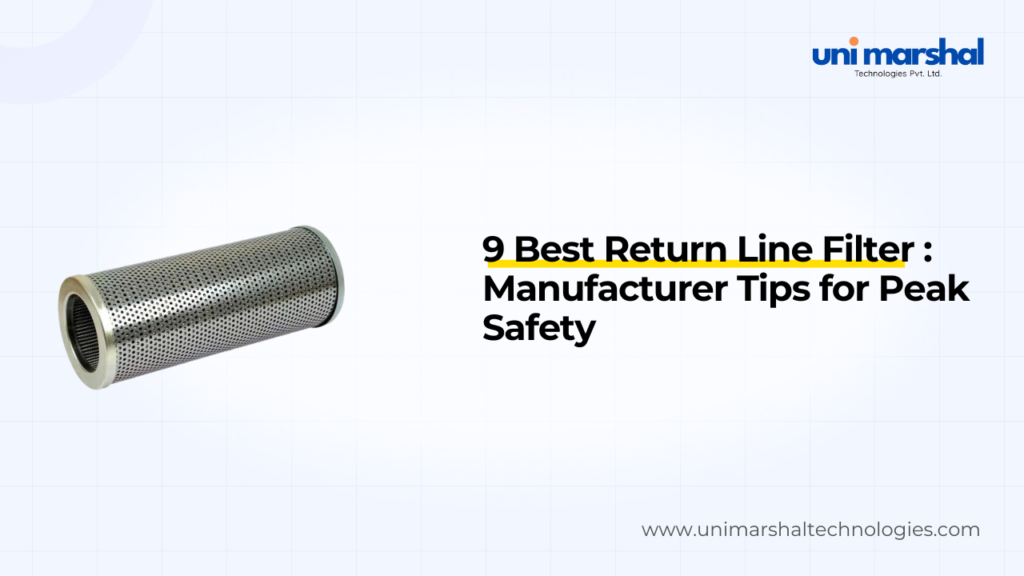
SECTION A: What Does a Return Line Filter Manufacturer Actually Do?
Return Line Filter Manufacturer plays a critical role in keeping hydraulic systems clean, safe, and long-lasting. Their work goes beyond making a product. They support system reliability at every stage.
A Return Line Filter is installed in the Hydraulic Return Line. It captures contaminants before oil goes back to the reservoir. This protects the entire system.
A manufacturer focuses on design, performance, and reliability. Their responsibility starts long before production and continues after delivery.
Core Responsibilities of a Manufacturer
A manufacturer handles multiple technical and practical tasks to ensure filters perform correctly in real working conditions.
They are responsible for:
- Designing filters suitable for pressure, flow, and oil type
- Selecting filtration media for effective particle removal
- Ensuring compatibility with hydraulic systems
- Testing filters for durability and performance
- Maintaining consistent manufacturing quality
Each step directly impacts system safety and uptime.
Understanding the Manufacturer’s Role Clearly
The Return Line Filter manufacturer role includes both engineering and support functions. This helps users avoid failures caused by poor filtration choices.
They bridge the gap between system requirements and real-world performance.
Key Areas They Manage
| Area | What It Means for the User |
| Design Engineering | Filters match system pressure and flow |
| Filtration Media | Efficient particle removal without flow loss |
| Manufacturing Quality | Consistent performance batch after batch |
| Testing & Inspection | Reduced risk of early failure |
| Technical Support | Correct filter selection and usage |
This table shows how each area affects daily operations.
How They Help Protect Hydraulic Systems
Manufacturers ensure filters remove harmful contaminants like metal particles, dust, and sludge.
Their work helps:
- Reduce component wear
- Maintain oil cleanliness
- Prevent unexpected breakdowns
- Extend pump and valve life
This protection directly improves system efficiency.
Customization and Application Knowledge
Every hydraulic system is different. A manufacturer understands industry-specific needs.
They often support:
- Custom sizes and connections
- Special filtration ratings
- High-temperature or heavy-duty applications
- Industry-specific standards
This ensures the filter fits the system, not the other way around.
Quality Control and Standards
Manufacturers follow strict internal checks. These checks prevent defects and ensure reliability.
Quality practices usually include:
- Raw material inspection
- In-process quality checks
- Final performance testing
- Documentation and traceability
These steps build trust in long-term use.
Why Their Expertise Matters to Buyers
Choosing the right manufacturer reduces operational risk. It ensures the filter performs as expected under load.
A knowledgeable manufacturer helps users avoid:
- Wrong micron ratings
- Flow restrictions
- Frequent clogging
- Premature filter failure
This guidance saves time and maintenance costs.
What Users Should Expect
A reliable manufacturer provides more than a product.
Users should expect:
- Clear technical information
- Consistent product quality
- Application guidance
- Long-term performance support
This makes hydraulic systems safer and easier to maintain.
SECTION B: What Does a Return Line Filter Manufacturer Actually Do?
Return Line Filter Manufacturer supports hydraulic systems by ensuring clean oil flows back safely to the reservoir, improving protection, reliability, and overall system life.
A Return Line Filter removes contaminants after hydraulic components, preventing internal damage while manufacturers apply engineering and quality control to deliver dependable filtration solutions.
Design and Engineering Responsibilities
A manufacturer starts with system analysis. They study pressure, flow rate, and operating conditions before designing the filter.
Their engineering tasks include:
- Selecting suitable micron ratings
- Designing housings for pressure safety
- Ensuring low flow restriction
- Matching filter size to system capacity
Good design prevents oil bypass and premature clogging.
Material and Media Selection
Material choice directly affects filter life and performance. Manufacturers select components based on application demands.
They focus on:
- Filter media efficiency
- Corrosion-resistant housings
- Strong seals and gaskets
- Compatibility with hydraulic oils
This ensures consistent filtration under working conditions.
Manufacturing and Quality Control
Production quality defines filter reliability. Each unit must meet consistent performance benchmarks.
Manufacturers follow structured checks aligned with Return Line Filter quality standards to maintain trust and repeat performance.
Key quality steps include:
- Raw material inspection
- Dimensional accuracy checks
- Flow and pressure testing
- Visual and functional inspection
These steps reduce the risk of system failure.
Testing and Performance Validation
Before filters reach users, they are tested for real operating stress. This confirms durability and efficiency.
Testing often covers:
- Burst pressure resistance
- Flow consistency
- Contaminant holding capacity
- Seal integrity
This testing protects users from unexpected downtime.
How Manufacturers Support System Protection
A Return Line Filter Manufacturer helps reduce wear across hydraulic components. Clean oil improves pump, valve, and actuator life.
Their work helps:
- Lower maintenance frequency
- Maintain oil cleanliness
- Improve system efficiency
- Reduce unplanned shutdowns
This makes filtration a preventive investment.
Customization and Application Knowledge
Different industries have different filtration needs. Manufacturers understand these variations.
They support customization for:
- Construction equipment
- Industrial machinery
- Power plants
- Mobile hydraulic systems
Custom solutions improve system compatibility.
Technical Guidance for Buyers
A reliable Return Line Filter Manufacturer guides users in choosing the correct filter. Wrong selection can reduce system efficiency.
They help users avoid:
- Incorrect micron ratings
- Mismatched flow capacity
- Poor housing strength
- Early filter clogging
This guidance reflects real-world experience.
Clear View of Manufacturer Responsibilities
| Area | Purpose |
| Design | Match filter to system conditions |
| Materials | Ensure durability and compatibility |
| Quality Control | Deliver consistent performance |
| Testing | Validate safety and efficiency |
| Technical Support | Assist correct filter selection |
This table summarizes how manufacturers contribute to hydraulic system reliability.
What Users Gain from a Reliable Manufacturer
Users benefit from expertise, consistency, and system knowledge.
They receive:
- Stable filtration performance
- Reduced operational risk
- Better equipment lifespan
- Predictable maintenance cycles
This value comes from experience, not just production.
SECTION C: Which Materials Are Best for Return Line Filters in 2026?
Return Line Filter Manufacturer focuses on material selection to handle pressure, oil temperature, contamination load, and long service life in modern hydraulic systems.
In 2026, material choice matters because systems run hotter, longer, and under tighter tolerances. The right materials reduce wear, prevent oil degradation, and improve filtration consistency.
Why Material Selection Is Critical
Filter materials directly affect performance, safety, and maintenance cycles. Poor material choices lead to clogging, corrosion, and system damage.
Key reasons materials matter:
- High-pressure oil flow stresses filter housings
- Hot oil can weaken low-grade metals
- Contaminants demand strong filtration media
- Long service intervals require durable construction
A reliable Return Line Filter Manufacturer selects materials based on real operating conditions, not cost alone.
Best Materials Used in Return Line Filters (2026)
The following Return Line Filter Materials are widely preferred for durability and filtration efficiency.
| Filter Component | Best Material | Why It Works |
| Filter Housing | Stainless Steel | Corrosion-resistant and pressure-safe |
| Filter Media | SS Wire Mesh | High dirt holding and reusability |
| Filter Media | Microglass Fiber | Fine filtration with stable flow |
| End Caps | Stainless Steel | Prevents deformation and leakage |
| Seals | Nitrile / Viton | Oil and temperature resistance |
This table shows how each material supports filter reliability.
Stainless Steel Housing Advantages
Stainless steel is the top choice for Return Line Filter housings in 2026.
Benefits include:
- Resistance to corrosion and rust
- Long service life in harsh environments
- Stable performance under pressure spikes
- Easy cleaning and reuse
These qualities make it ideal for industrial and mobile hydraulics.
Filter Media That Performs Under Load
The filter media does the actual contaminant removal. Manufacturers choose based on cleanliness targets.
Common media options:
- SS wire mesh for reusable filtration
- Micro glass for fine particle removal
- Cellulose blends for light-duty systems
Media selection balances filtration level and oil flow stability.
Seal and End Cap Importance
Seals and end caps are often overlooked but critical for safety.
Manufacturers prioritize:
- Strong bonding between media and caps
- Oil-compatible seal materials
- Resistance to pressure pulsation
Weak seals cause bypass and oil contamination.
How Manufacturers Decide the Right Material Mix
Material selection depends on application needs, not trends.
Manufacturers evaluate:
- System pressure and flow rate
- Oil type and operating temperature
- Contamination level
- Maintenance expectations
This approach reflects engineering expertise and field experience.
Material Selection Summary for Users
Choosing the right materials ensures system protection and stable filtration.
Users should expect:
- Durable housings
- Efficient filtration media
- Reliable seals
- Long maintenance intervals
Material quality directly defines filter performance and system safety.

SECTION D: Why Filtration Efficiency Matters When Choosing a Manufacturer
Return Line Filter Manufacturer plays a direct role in protecting hydraulic systems by controlling how effectively contaminants are removed before oil returns to the reservoir.
Filtration efficiency decides system lifespan, maintenance cost, and failure risk. Poor efficiency allows particles to circulate, causing wear, pressure loss, and unplanned downtime.
What Filtration Efficiency Really Means
Filtration efficiency is the filter’s ability to capture harmful particles without restricting oil flow.
It depends on:
- Micron rating accuracy
- Filter media structure
- Flow stability under load
- Dirt holding capacity
This is why Return Line Filter Filtration Efficiency must be verified, not assumed.
Why Efficiency Should Guide Manufacturer Selection
A manufacturer’s filtration design reflects their engineering strength and field experience.
High efficiency ensures:
- Clean oil circulation
- Reduced internal wear
- Stable system pressure
- Longer component life
Low efficiency leads to recurring contamination issues.
How Manufacturers Control Filtration Performance
A reliable manufacturer focuses on tested designs, not generic specifications.
They control efficiency through:
- Precision filter media selection
- Consistent pleating patterns
- Strong end-cap bonding
- Controlled flow paths
These factors prevent particle bypass.
Impact of Poor Filtration Efficiency
Low-quality filters fail silently and cause damage over time.
Common problems include:
- Valve sticking
- Pump scoring
- Heat generation
- Oil degradation
These failures increase maintenance frequency and cost.
What a Good Manufacturer Does Differently
A dependable Return Line Filter Manufacturer validates filtration performance before supply.
They ensure:
- Real-world testing under pressure
- Stable micron retention
- Balanced flow and filtration
- Documented performance checks
This shows technical credibility and accountability.
Filtration Efficiency vs System Safety
| Filtration Level | System Impact |
| High Efficiency | Clean oil, longer component life |
| Medium Efficiency | Partial protection, moderate wear |
| Low Efficiency | Rapid wear and frequent failures |
This table highlights why efficiency matters in daily operations.
What Buyers Should Look For
Buyers should evaluate filtration efficiency, not just price.
Key checks include:
- Tested micron ratings
- Media quality consistency
- Flow capacity matching system needs
- Manufacturer’s technical support
These indicators show real filtration capability.
Why Efficiency Reflects Manufacturer Expertise
Efficient filtration is not accidental. It comes from engineering knowledge and controlled manufacturing.
Manufacturers with strong efficiency focus help users achieve:
- Predictable maintenance cycles
- Stable hydraulic performance
- Lower operational risk
This makes filtration efficiency a decision-making priority.
SECTION E: What Certifications Should a Reliable Return Line Filter Manufacturer Have?
Return Line Filter Manufacturer proves reliability through certifications that validate product quality, process control, and performance consistency in hydraulic filtration systems.
Certifications show that filters are designed, tested, and produced under controlled standards. They help buyers trust safety, durability, and Return Line Filter filtration efficiency without relying on claims alone.
Why Certifications Matter in Filtration Manufacturing
Certifications are not paperwork. They reflect engineering discipline and controlled manufacturing.
They ensure:
- Consistent product quality
- Verified testing methods
- Process traceability
- Reduced risk of system failure
Certified manufacturers follow documented procedures at every stage.
Core Certifications a Manufacturer Should Have
These certifications indicate credibility and operational discipline.
| Certification | What It Confirms |
| ISO 9001 | Quality management and consistency |
| ISO 14001 | Environment-safe manufacturing |
| ISO 45001 | Workplace safety standards |
| In-house Test Compliance | Filter performance validation |
| Material Traceability | Controlled raw material sourcing |
This table helps users quickly understand certification value.
ISO 9001 and Quality Control
ISO 9001 is the most important baseline certification.
It ensures:
- Standardized production processes
- Controlled inspection procedures
- Continuous improvement systems
- Customer-focused quality checks
Without it, consistency cannot be guaranteed.
Testing and Performance Validation
A reliable manufacturer tests filters beyond basic inspection.
Testing usually covers:
- Flow rate stability
- Pressure resistance
- Media bonding strength
- Contaminant retention
These tests support real-world system safety.
Certification and Filtration Performance Link
Certifications directly impact filtration results.
They help ensure:
- Accurate micron ratings
- Stable oil flow
- No media bypass
- Reliable dirt holding capacity
This protects critical hydraulic components.
Industry-Specific Compliance
Some industries require additional compliance based on application risk.
Manufacturers may align with:
- Industrial machinery standards
- Mobile hydraulic safety norms
- Power and heavy equipment guidelines
Compliance shows application knowledge.
What Buyers Should Verify
Buyers should always ask for proof, not promises.
Key checks include:
- Valid certification copies
- Scope covering filtration products
- Updated audit records
- Documented testing procedures
Transparency reflects trustworthiness.
Certification as a Sign of Expertise
A certified Return Line Filter Manufacturer demonstrates technical authority and accountability.
It shows:
- Structured engineering practices
- Controlled manufacturing
- Commitment to safety and performance
Certifications make manufacturer capability visible and measurable.
SECTION F: How to Evaluate Customization Options from Return Line Filter Manufacturers
Return Line Filter Manufacturer plays a key role in offering solutions tailored to system requirements. Evaluating customization ensures filters fit hydraulic systems perfectly, improving efficiency and safety.
Customization is essential for specific operating conditions. Custom Return Line Filters help manage flow rate, pressure, oil type, and contamination levels, meeting unique industrial demands.
Key Factors to Check for Customization
Before selecting a manufacturer, consider these points:
- Available filter sizes and dimensions
- Compatible micron ratings for specific applications
- Material options for housing and media
- Pressure and temperature tolerances
- End connections and sealing types
This ensures the filter integrates seamlessly into your system.
How Manufacturers Support Tailored Solutions
Reliable manufacturers provide engineering and technical guidance for custom filters.
| Customization Aspect | What It Means for the User |
| Filter Media Choice | Optimized particle removal efficiency |
| Housing Material | Longevity under pressure and temperature |
| Flow Rate Adaptation | Maintains hydraulic performance |
| Connection Types | Easy installation and compatibility |
| Special Coatings | Resistance to corrosion or wear |
This table summarizes customization areas and their practical benefits.
Evaluating Manufacturer Expertise
A capable manufacturer demonstrates:
- Proven track record in tailored solutions
- Technical consultation for system needs
- Prototyping and testing before production
- Documentation of performance under real conditions
This evaluation ensures the filter meets precise operational requirements.
Benefits of Properly Customized Filters
Using custom filters prevents:
- Bypass of contaminants
- Flow restriction or pressure drop
- Premature wear of hydraulic components
- Frequent maintenance and system downtime
Short, focused customization reduces operational risk.
How Buyers Can Verify Options
Users should ask for:
- Specification sheets for custom products
- Sample testing or prototype feedback
- Media and housing options available
- Compliance with industry standards
Clear communication with the manufacturer ensures the solution fits perfectly.

SECTION G: Common Mistakes Buyers Make When Selecting a Return Line Filter Manufacturer
Return Line Filter Manufacturer selection impacts system reliability and maintenance. Many buyers unknowingly make mistakes that lead to poor performance, frequent downtime, and higher costs.
These errors often occur due to lack of research, misunderstanding of technical requirements, or focusing only on price instead of quality, material, and support. Choosing Return Line Filter Manufacturer wisely is crucial to ensure efficient hydraulic system operation.
Frequent Buyer Mistakes
When selecting a manufacturer, buyers often:
- Ignore micron rating accuracy
- Overlook housing and media materials
- Neglect manufacturer certifications and standards
- Fail to check filtration efficiency under real conditions
- Ignore after-sales support and guidance
These mistakes lead to frequent replacements and system wear.
How Mistakes Affect System Performance
Poor manufacturer selection can cause:
- Contaminant bypass
- Reduced pump and valve life
- Unexpected maintenance downtime
- Increased operational costs
Understanding these risks helps buyers prioritize quality over price.
Key Areas to Evaluate
| Evaluation Area | Why It Matters |
| Filter Media & Housing | Determines durability and contaminant removal |
| Micron Rating Accuracy | Ensures correct particle filtration |
| Certifications | Confirms quality and compliance |
| After-Sales Support | Provides technical guidance and troubleshooting |
| Filtration Testing | Validates performance in real systems |
This table helps buyers quickly identify critical evaluation points.
Tips to Avoid Common Mistakes
- Compare multiple manufacturers’ specifications
- Verify real-world performance and test data
- Check material and design compatibility with your system
- Review certifications and industry compliance
- Confirm availability of technical support
Following these steps reduces risks and improves hydraulic system efficiency.
Why Smart Selection Matters
A well-chosen Return Line Filter Manufacturer ensures:
- Reliable, long-lasting filtration
- Reduced downtime and maintenance
- Optimal hydraulic system efficiency
- Safer, smoother operations
Careful evaluation prevents avoidable errors and protects equipment investment.
Additional Considerations When Choosing a Manufacturer
When evaluating a Return Line Filter Manufacturer, buyers should also focus on practical operational factors that ensure long-term system reliability.
- Delivery timelines and production capacity
- Customization options for specific hydraulic applications
- Compatibility with system oil types and pressure ratings
- Proven track record in industrial projects
- Transparent communication and documentation
| Factor | How It Benefits You |
| Delivery & Capacity | Avoid production delays and downtime |
| Customization | Tailored solutions for optimal performance |
| Compatibility | Prevents premature wear and failure |
| Experience | Confidence in real-world performance |
| Documentation | Easy maintenance and traceability |
These considerations complement technical evaluation and help make smarter, risk-free decisions.
SECTION H: How After-Sales Support Impacts Long-Term Filter Performance
Return Line Filter Manufacturer plays a crucial role in hydraulic system reliability, not only through product quality but also by providing effective after-sales support to maintain long-term performance.
After-sales support ensures filters operate efficiently throughout their service life, minimizing system downtime, preventing contamination, and extending component lifespan. Return Line Filter after sales support guides users on maintenance schedules, troubleshooting, and optimal filter use.
Key Benefits of Strong After-Sales Support
Reliable support improves operational efficiency and user confidence. Manufacturers offering expert guidance help prevent common issues.
- Assistance with filter installation
- Guidance on maintenance intervals
- Replacement and spare part support
- Troubleshooting under pressure
- Technical advice for system optimization
This reduces operational risk and improves overall system safety.
How Support Influences Filter Longevity
Continuous technical assistance ensures filters maintain intended Return Line Filter filtration efficiency. Proper maintenance and guidance prevent bypass, clogging, and premature failure.
| Support Area | Impact on System |
| Installation Guidance | Ensures correct fit and function |
| Maintenance Scheduling | Extends filter life and efficiency |
| Spare Part Availability | Reduces downtime during replacements |
| Troubleshooting | Resolves issues quickly and accurately |
| Technical Advice | Optimizes system performance and reliability |
Why Buyers Should Prioritize After-Sales Services
Choosing a manufacturer with strong support guarantees long-term benefits. Expert support avoids unnecessary maintenance and system failures.
- Reduces unexpected breakdowns
- Protects pumps, valves, and actuators
- Maintains hydraulic system performance
- Provides confidence in system reliability
How Manufacturers Deliver Effective Support
Top Manufacturer teams include engineers, field technicians, and customer support specialists. They provide documentation, remote guidance, and on-site assistance for complex systems.
- Technical manuals and installation guides
- Online and on-site training sessions
- Real-time troubleshooting assistance
- Preventive maintenance recommendations
This ensures filters perform as designed, protecting costly equipment.
Enhancing Operational Efficiency Through Support
After-sales support is an extension of product quality. Manufacturers offering consistent support help users:
- Maintain peak filter efficiency
- Reduce oil contamination risks
- Avoid costly downtime
- Optimize system longevity
Table Summary of Support Benefits
| Feature | Benefit |
| Installation Support | Correct setup, no errors |
| Maintenance Guidance | Longer service life |
| Spare Parts | Immediate replacements |
| Troubleshooting | Quick issue resolution |
| Technical Advice | Maximize system performance |
Strong after-sales support ensures filters continue to protect hydraulic systems efficiently, making it a key factor in choosing a reliable Return Line Filter Manufacturer.
SECTION I: Return Line Filter Manufacturer Pricing: How to Balance Cost and Quality
Return Line Filter Manufacturer pricing depends on materials, design, filtration efficiency, and production quality. Buyers must evaluate cost without compromising performance and system reliability.
Low-cost filters often use inferior media or housings. High-quality filters ensure longevity, proper particle removal, and minimal maintenance, offering better long-term value despite higher upfront costs.
Factors Influencing Pricing
Several aspects determine filter cost and performance balance:
- Housing material type (steel, stainless steel)
- Filter media quality and micron rating
- Production process and quality control
- Testing and performance validation
- Customization options for specific systems
Understanding these factors helps buyers make informed investment decisions.
How to Evaluate Cost vs. Quality
When assessing filters, price should not be the only consideration.
- Compare long-term operational savings versus upfront cost
- Evaluate maintenance frequency and replacement needs
- Verify manufacturer’s quality standards
- Consider compatibility with your hydraulic system
This ensures filters provide reliable performance at an acceptable price.
Pricing Tiers and What They Offer
| Price Range | Features | Benefits |
| Low | Basic housing, cellulose media | Short lifespan, minimal upfront cost |
| Medium | Steel housing, blended media | Balanced performance and cost |
| Premium | Stainless steel housing, microglass or wire mesh media | Long life, high filtration efficiency, minimal maintenance |
This table helps buyers quickly understand cost-quality trade-offs.
Tips for Smart Purchasing
- Avoid choosing based solely on lowest price
- Ask manufacturers for performance data and material specifications
- Consider total cost of ownership, including downtime and maintenance
- Choose a trusted manufacturer with proven reliability
Balancing Cost and Efficiency
Optimal purchasing balances initial cost with system safety and longevity. Investing in higher-quality filters reduces maintenance, prevents component wear, and enhances hydraulic system efficiency.
- High-quality filters prevent contaminant bypass
- Reduce pump, valve, and actuator damage
- Maintain stable hydraulic pressure and flow
- Minimize unexpected downtime
Practical Advice for Buyers
Evaluate multiple manufacturers before committing. Ask for quotes alongside technical specifications to compare:
| Evaluation Aspect | Why It Matters |
| Material | Longevity and durability |
| Media Type | Filtration efficiency |
| Manufacturing Process | Consistency and quality control |
| System Compatibility | Reduces risk of premature failure |
| Warranty | Ensures manufacturer accountability |
Final Insights
Balancing cost and quality ensures filters protect your hydraulic system while optimizing operational budgets. Choosing the right Return Line Filter Manufacturer directly impacts system performance and overall reliability.
- Prioritize performance over cheapest options
- Review material and media quality
- Consider long-term maintenance costs
- Make decisions based on verified data
This approach guarantees maximum value and dependable filtration for industrial and mobile hydraulic systems.
FREQUENTLY ASKED QUESTIONS
Other Industry Topics Are Exploring
Return Line Filter || Hydraulic return line filters || Return line filter materials || Return line filter micron rating || Return line filter housing || Tank-mounted return line filter || Return line filter benefits || Hydraulic filter performance testing || Return line filter installation tips || Best Return Line Filter Manufacturer