

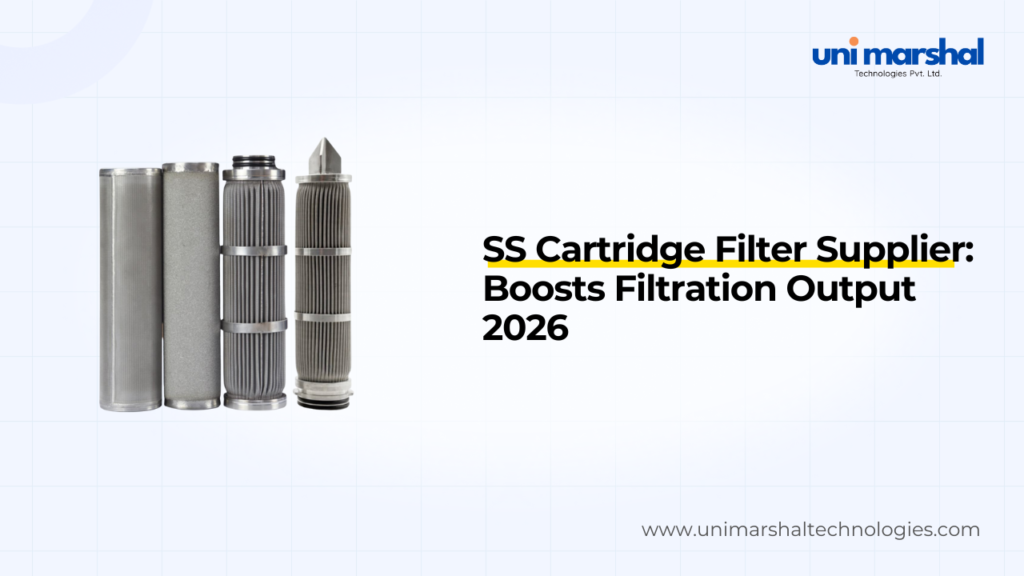
SECTION A: What Is an SS Cartridge Filter and How Does It Affect Filtration Performance
SS Cartridge Filter Supplier plays a key role in delivering filters that handle high pressure, temperature, and repeated cleaning cycles. Before choosing one, it is important to understand what an SS cartridge filter actually is and how it works.
An SS cartridge filter is a filtration element made from stainless steel mesh or sintered stainless steel.
It is designed to remove solid particles from liquids or gases in industrial systems.
These filters are widely used because they are reusable, strong, and stable under harsh operating conditions.
What Makes an SS Cartridge Filter Different
SS cartridge filters are not disposable like paper or polymer filters. They are built for long-term industrial use.
Key characteristics include:
- Made from stainless steel grades like SS 304 or SS 316
- Can be cleaned and reused multiple times
- Suitable for high temperature and corrosive fluids
- Maintains shape under high pressure
This construction directly impacts filtration reliability.
How SS Cartridge Filters Affect Filtration Performance
Filtration performance depends on how consistently a filter removes particles without disrupting flow. SS cartridge filters are designed to balance both.
They improve SS cartridge filter performance by:
- Providing uniform pore structure
- Allowing stable flow rate over time
- Preventing media breakage or collapse
- Supporting consistent pressure drop
This makes them ideal for continuous industrial operations.
Key Performance Factors Explained Simply
Below is a clear breakdown of how SS cartridge filters influence system performance:
| Performance Factor | What It Means for the User |
| Micron Rating | Controls particle size removal accuracy |
| Flow Rate | Ensures smooth liquid or gas movement |
| Pressure Drop | Reduces energy loss in the system |
| Structural Strength | Prevents filter damage under pressure |
| Cleanability |
Allows reuse without performance loss |
This table helps users understand why material and design matter.
Where Filtration Performance Matters Most
SS cartridge filters are chosen when process stability is critical. Poor filtration can damage equipment or affect product quality.
Common applications include:
- Chemical processing plants
- Oil and gas filtration systems
- Pharmaceutical manufacturing
- Food and beverage processing
- Water treatment units
Each application demands predictable filtration behavior.
Why Supplier Quality Influences Performance
Even the best filter design fails if manufacturing quality is poor. Precision welding, uniform mesh, and accurate sizing are essential.
A reliable SS Cartridge Filter Supplier ensures:
- Consistent micron accuracy
- Proper material certification
- Tested flow and pressure tolerance
- Dimensional fit for filter housings
This directly affects how the filter performs in real conditions.
Simple Way to Judge Filter Effectiveness
Users can quickly assess filter performance by observing:
- Stable flow after long usage
- No sudden pressure spikes
- Easy cleaning without deformation
- Same filtration result after reuse
These signs indicate a well-made SS cartridge filter.
This section helps users clearly understand what an SS cartridge filter is, how it works, and why its performance depends on design, material, and supplier quality.
SECTION B: Why SS Cartridge Filter Material Quality Matters for Long Term Use
SS Cartridge Filter Supplier selection becomes important when long term performance, safety, and operating cost matter. Material quality is the foundation of how a stainless steel cartridge filter behaves over time.
SS cartridge filters are exposed to pressure, heat, chemicals, and repeated cleaning.
If the material quality is poor, performance drops quickly.
What Material Quality Means in SS Cartridge Filters
Material quality refers to the grade, purity, and structure of stainless steel used. It directly affects strength, corrosion resistance, and filtration stability.
High quality material ensures:
- Consistent pore structure
- Strong weld joints
- Resistance to rust and scaling
- Stable performance after multiple cleanings
This is why SS cartridge filter material quality should never be ignored.
Common Stainless Steel Grades Used
Different grades behave differently in industrial conditions. Choosing the wrong grade shortens filter life.
| SS Grade | Key Property | Suitable Usage |
|---|---|---|
| SS 304 | Good corrosion resistance | Water, food processing |
|
SS 316 |
Higher chemical resistance |
Chemicals, pharma |
|
SS 316L |
Low carbon, better welding |
High purity processes |
This table helps users quickly match material with application needs.
How Material Quality Affects Long Term Use
Long term use means the filter keeps working without failure. Low grade material weakens faster under stress.
Good material quality supports:
- Stable filtration accuracy over time
- No deformation during high pressure
- Lower risk of cracks or leaks
- Reliable performance after cleaning cycles
This reduces downtime and replacement frequency.
Impact on Cleaning and Reusability
SS cartridge filters are designed to be reusable. Material quality decides how well they handle cleaning methods.
High quality material allows:
- Backwashing without mesh damage
- Chemical cleaning without corrosion
- Thermal cleaning without warping
- Repeated reuse without performance loss
Poor quality material often fails after few cleanings.
Safety and Process Reliability
In many industries, filter failure can damage equipment or contaminate products. Material quality plays a silent but critical role here.
Strong stainless steel material:
- Prevents particle shedding
- Maintains structural integrity
- Protects downstream equipment
- Supports process consistency
This is essential in regulated industries.
How to Identify Good Material Quality
Users do not need technical expertise to spot quality issues. Some visible signs make evaluation easier.
Look for:
- Smooth and uniform surface finish
- Even mesh structure without gaps
- Strong, clean weld joints
- No discoloration or rough edges
These signs usually reflect good manufacturing practices.
Role of the Supplier in Material Quality
Material quality depends on sourcing, processing, and inspection. A reliable SS Cartridge Filter Supplier focuses on all three areas.
They ensure:
- Certified raw materials
- Controlled manufacturing processes
- Dimensional and strength checks
- Consistent quality across batches
This approach supports long term filtration reliability.
This section explains clearly why material quality matters, how it affects performance, and what users should observe before choosing an SS cartridge filter for long term use.
SECTION C : How the Right SS Cartridge Supplier Ensures Accurate Micron Rating
SS Cartridge Filter Supplier choice directly affects how accurately a filter removes particles. Micron rating is not just a number. It defines filtration reliability, product quality, and equipment safety.
Micron rating refers to the smallest particle size a filter can capture. Even slight variation can change system performance.
What Micron Rating Really Means
Micron rating measures filtration precision. Lower micron value means finer filtration.
For users, accurate rating ensures:
- Consistent particle removal
- Stable product quality
- Protection of downstream equipment
- Predictable system performance
This makes micron accuracy critical in industrial filtration.
Why Inaccurate Micron Rating Creates Problems
When micron rating is not controlled, filtration becomes unreliable. This often happens with poorly manufactured filters.
Common issues include:
- Particles passing through the filter
- Faster clogging of downstream systems
- Pressure fluctuations
- Increased maintenance cost
These problems are avoidable with proper supplier control.
How the Right Supplier Maintains Micron Accuracy
Accurate micron rating starts with precise manufacturing. The supplier controls every production stage.
A reliable supplier focuses on:
- Uniform mesh or sintered structure
- Controlled pore size distribution
- Precision cutting and welding
- Clean assembly environment
This process ensures the filter performs as rated.
Testing Methods Used to Verify Micron Rating
Testing is essential to confirm actual filtration performance. Trusted suppliers do not rely on assumptions.
| Testing Step | Purpose |
| Bubble point testing | Confirms pore size consistency |
| Flow rate testing | Verifies filtration stability |
| Visual inspection | Detects mesh defects |
| Dimensional checks | Ensures proper housing fit |
This table helps users understand how micron accuracy is verified.
Role of Material and Construction
Material quality supports micron stability during operation. Weak materials deform under pressure.
High quality construction ensures:
- Pores remain consistent under load
- No stretching of mesh
- No change after repeated cleaning
- Long term filtration reliability
This directly supports SS cartridge filter micron rating accuracy.
Why Application Knowledge Matters
Different industries need different micron levels. A skilled supplier understands this difference.
They guide users on:
- Required micron level for each process
- Flow rate compatibility
- Pressure limitations
- Cleaning method impact
This prevents over or under filtration.
Signs of a Filter with Accurate Micron Rating
Users can identify accurate filtration through performance behavior. Results are visible during operation.
Look for:
- Consistent output quality
- Stable pressure drop
- No unexpected contamination
- Repeatable results after cleaning
These signs reflect good manufacturing control.
Supplier Responsibility Beyond Manufacturing
A dependable SS Cartridge Filter Supplier does more than supply products. They ensure filtration accuracy stays consistent.
Their responsibility includes:
- Batch level quality checks
- Clear micron specifications
- Process traceability
- Technical support when needed
This section explains how supplier expertise, testing, and process control ensure accurate micron rating and reliable filtration performance without confusion or hidden risks.

SECTION D: Impact of Supplier Manufacturing Standards on Filtration Efficiency
SS Cartridge Filter Supplier manufacturing standards decide how efficiently a filter removes contaminants.
Filtration efficiency depends on precision, consistency, and quality control at every production stage.
Even small production errors can reduce filtration performance. This is why manufacturing discipline matters in stainless steel cartridge filters.
What Manufacturing Standards Mean in Filtration
Manufacturing standards define how filters are designed, built, and inspected. They ensure every unit performs the same way.
Strong standards focus on:
- Material inspection before production
- Controlled forming of filter media
- Accurate welding and sealing
- Final inspection before dispatch
These steps protect filtration efficiency.
How Standards Influence Filtration Efficiency
Filtration efficiency means removing particles without blocking flow. Poor manufacturing disrupts this balance.
High standards help by:
- Maintaining uniform pore size
- Preventing bypass leakage
- Ensuring tight end cap sealing
- Keeping flow paths consistent
This ensures predictable filtration results.
Key Production Areas That Affect Efficiency
Each manufacturing stage influences how the filter performs. Skipping checks creates hidden defects.
| Production Stage | Effect on Filtration Efficiency |
| Media forming | Controls particle capture accuracy |
| Welding quality | Prevents leakage and bypass |
| Dimensional accuracy | Ensures proper housing fit |
| Surface finishing | Reduces particle shedding |
This table helps users quickly see where efficiency is controlled.
Role of Process Control and Inspection
Inspection is not optional in filtration manufacturing. It confirms the filter meets design expectations.
Effective inspection includes:
- Visual checks for defects
- Measurement of critical dimensions
- Strength testing under pressure
- Flow consistency verification
These checks maintain performance consistency.
Importance of Repeatability in Production
One good filter is not enough. Every batch must perform equally.
Strong SS cartridge filter manufacturing standards ensure:
- Same pore structure in every unit
- Stable filtration across batches
- No performance variation over time
- Reliable system behavior
Repeatability builds trust in filtration systems.
Impact on Long Term Filtration Performance
Manufacturing quality affects how filters behave after repeated use. Low standards cause early performance loss.
High standards support:
- Stable efficiency after cleaning
- Resistance to deformation
- Lower clogging risk
- Longer service life
This reduces downtime and operating cost.
How Users Benefit from High Manufacturing Standards
Users may not see the manufacturing process. They feel the results during operation.
Benefits include:
- Clean and consistent output
- Smooth pressure behavior
- Reduced maintenance effort
- Predictable replacement cycles
These outcomes reflect disciplined manufacturing.
Supplier Accountability and Filtration Reliability
A dependable SS Cartridge Filter Supplier takes responsibility for process control. They document, monitor, and improve production methods.
Their approach includes:
- Defined production procedures
- Trained workforce
- Equipment calibration
- Continuous quality monitoring
This section explains how manufacturing standards directly shape filtration efficiency and why supplier discipline is essential for reliable industrial filtration systems.
SECTION E: Role of SS Cartridge Filter Supplier in Flow Rate and Pressure Drop Control
SS Cartridge Filter Supplier plays a direct role in controlling flow rate and pressure drop inside a filtration system.
These two factors decide system stability, energy usage, and filtration reliability.
Flow rate refers to how smoothly fluid passes through the filter. Pressure drop shows how much resistance the filter creates.
Why Flow Rate and Pressure Drop Matter
Balanced flow and pressure ensure the system runs without stress. Poor control leads to performance loss.
Users face issues like:
- Reduced process efficiency
- Higher pump energy consumption
- Uneven filtration results
- Frequent filter replacement
This is why design accuracy is critical.
How Supplier Design Choices Affect Flow
Filter design controls how fluid moves through the cartridge. Suppliers decide this during manufacturing.
Key design elements include:
- Mesh or sintered structure
- Pore distribution pattern
- Cartridge diameter and length
- End cap design
These factors directly influence SS cartridge filter flow rate behavior.
Manufacturing Precision and Pressure Drop Control
Pressure drop increases when internal resistance rises. Poor manufacturing creates unnecessary blockage.
High precision manufacturing ensures:
- Uniform pore structure
- Smooth internal surfaces
- No partial blockage zones
- Consistent flow channels
This keeps pressure drop within safe limits.
Flow and Pressure Relationship Explained Simply
The relationship between flow rate and pressure drop must stay balanced. Too much restriction harms system performance.
| Filter Feature | Effect on Flow Rate | Effect on Pressure Drop |
| Uniform pore size | Smooth fluid movement | Stable pressure |
| Proper cartridge size | Balanced throughput | Controlled resistance |
| Clean weld joints | No flow obstruction | Reduced pressure loss |
| Accurate housing fit | Even flow distribution |
Prevents spikes |
This table helps users quickly understand system behavior.
SS Cartridge Filter Supplier Role in Application Matching
Different processes require different flow capacities. A skilled supplier understands these needs.
They guide users on:
- Suitable cartridge dimensions
- Micron level versus flow balance
- Operating pressure limits
- Cleaning impact on flow
This avoids overloading the filtration system.
Impact of Poor Supplier Selection
Wrong supplier decisions create hidden operational problems. These issues appear during long term use.
Common problems include:
- Sudden pressure increase
- Reduced output flow
- Filter deformation
- System shutdown risks
These are often caused by poor design control.
Importance of Testing and Validation
Testing confirms real-world performance. Responsible suppliers test before delivery.
Testing covers:
- Flow consistency checks
- Pressure drop measurement
- Structural strength under load
- Performance after cleaning
These steps protect system stability.
Supplier Responsibility in Long Term Control
A reliable SS Cartridge Filter Supplier supports consistent operation. Their responsibility goes beyond product delivery.
They ensure:
- Consistent design standards
- Controlled production quality
- Clear flow specifications
- Technical support when required
This section explains how supplier expertise and manufacturing discipline control flow rate and pressure drop, ensuring stable and efficient filtration system performance.
SECTION F: Why Industry Specific Experience of SS Cartridge Filter Suppliers Is Critical
SS Cartridge Filter Supplier experience matters because every industry works under different operating conditions.
A filter that performs well in one sector may fail in another.
Industry knowledge helps suppliers design filters that match real process demands.
What Industry Specific Experience Means
Industry specific experience means understanding how filters behave in actual working environments.
This includes temperature, pressure, chemicals, and operating cycles.
Experienced suppliers understand:
- Process flow patterns
- Contaminant types
- Cleaning frequency
- Safety and compliance needs
This knowledge reduces performance risk.
Why One Filter Cannot Fit All Industries
Industrial processes vary widely. Using a generic filter often leads to system issues.
Different industries demand different features:
- Chemicals need corrosion resistance
- Food processing needs hygiene
- Oil and gas needs high pressure strength
- Pharma needs precision filtration
Industry experience helps align design with usage.
How Experience Improves Filtration Accuracy
Suppliers with industry exposure know real filtration challenges. They design based on application, not assumptions.
Their experience helps with:
- Correct micron selection
- Suitable material grade choice
- Stable flow and pressure balance
- Proper housing compatibility
This directly improves filtration reliability.
Industry Based Application Understanding
Each sector applies filters differently. This impacts performance expectations.
| Industry | Key Filtration Requirement |
| Chemical | Resistance to aggressive fluids |
| Food & Beverage | Cleanable and hygienic design |
| Oil & Gas | High pressure durability |
| Pharmaceutical | Consistent particle control |
| Water Treatment |
Long service life |
This table helps users see how requirements differ.
Role in Handling SS Cartridge Filter Industrial Applications
SS cartridge filter industrial applications involve complex operating conditions. Suppliers with industry knowledge anticipate these challenges.
They account for:
- Temperature variation
- Pressure fluctuations
- Cleaning method impact
- Continuous operation cycles
This reduces unexpected failures.
Impact on Installation and System Fit
Industry experienced suppliers understand equipment standards. This avoids installation problems.
They ensure:
- Accurate cartridge dimensions
- Proper sealing method
- Housing compatibility
- Easy maintenance access
Correct fit improves system efficiency.
Risk of Choosing Inexperienced Suppliers
SS Cartridge Filter Suppliers without industry exposure rely on generic designs. This increases operational risk.
Common issues include:
- Rapid performance decline
- Frequent clogging
- Incompatible materials
- Higher maintenance effort
These issues increase long term cost.
Value of Technical Guidance
Experienced suppliers offer more than products. They provide practical guidance.
Their support includes:
- Application specific recommendations
- Performance expectations
- Maintenance advice
- Process optimization suggestions
Why Supplier Experience Builds Trust
A reliable SS Cartridge Filter Supplier builds trust through proven results. Experience reflects tested solutions, not theory.
This section explains why industry specific experience is critical for reliable filtration, stable performance, and long term system efficiency across demanding industrial environments.

SECTION G: How a Reliable SS Cartridge Supplier Improves Filter Life and Durability
SS Cartridge Filter Supplier quality directly impacts how long a filter lasts and how well it performs over time.
Durability is essential for reducing maintenance costs and avoiding downtime in industrial systems.
A well-made SS cartridge filter maintains its structure and filtration efficiency even under high pressure, temperature, and repeated cleaning.
Factors That Affect Filter Life
Filter lifespan depends on design, material, and manufacturing quality.
Reliable suppliers focus on all these areas.
Key factors include:
- Material strength and corrosion resistance
- Precision in mesh or sintered structure
- Proper welding and sealing
- Accurate dimensional control
High quality in these areas extends the SS cartridge filter lifespan.
How Supplier Expertise Enhances Durability
Experienced suppliers understand industrial conditions and tailor filters accordingly.
This ensures longevity and consistent performance.
Benefits include:
- Filters resist deformation under pressure
- Mesh maintains particle capture accuracy
- End caps and seals remain intact
- Repeated cleaning does not reduce efficiency
Material and Construction Role
Durable filters start with the right stainless steel grade.
Material quality and construction are key.
| Material Feature | Impact on Durability |
| High grade SS 304/316 | Corrosion and chemical resistance |
| Uniform mesh structure | Stable filtration over time |
| Strong welds | Prevents leaks and bypass |
| Thick end caps | Handles high pressure and stress |
This table helps users understand which components improve filter life.
Maintenance and Cleaning Compatibility
Filters are reusable, but poor material fails under cleaning stress.
Reliable suppliers design for repeated maintenance.
Advantages include:
- Easy backwashing without damage
- Resistance to chemical cleaning
- Maintains shape after thermal cleaning
- Reduces need for frequent replacement
Consistent Performance Over Time
Long-lasting filters provide steady filtration without efficiency loss.
This protects industrial processes and downstream equipment.
Signs of good filter durability:
- Stable flow rate
- No sudden pressure spikes
- Minimal clogging over repeated cycles
- Consistent particle removal
Choosing the Right Supplier Matters
Selecting a competent SS Cartridge Filter Supplier ensures filters are built for real-world conditions.
They guarantee longevity and reduce operational issues.
A good supplier provides:
- Certified raw materials
- Controlled manufacturing processes
- Batch-level quality checks
- Technical guidance for proper use
This section explains clearly how a reliable supplier improves SS cartridge filter lifespan and overall durability, ensuring long-term industrial performance.
SECTION H: Common Problems Caused by Choosing the Wrong SS Cartridge Supplier
SS Cartridge Filter Supplier selection is critical for reliable filtration.
Choosing the wrong supplier can lead to operational issues, higher costs, and frequent downtime.
Even small mistakes in design, material, or manufacturing affect filter performance.
Why Supplier Choice Matters
A competent supplier ensures consistent quality, accurate micron rating, and durable construction.
Poor suppliers often overlook critical details.
Potential consequences include:
- Filters failing prematurely
- Uneven flow or pressure
- Reduced filtration efficiency
- Increased maintenance frequency
Typical Problems with Wrong SS Cartridge Filter Supplier
Incorrect supplier selection causes common SS cartridge filter supplier issues.
These can disrupt industrial processes.
| Problem | Cause | Impact |
| Filter deformation | Low-quality materials | Loss of filtration accuracy |
| Uneven flow | Poor design or pore structure | Pressure drop spikes |
| Corrosion | Substandard stainless steel | Shortened filter life |
| Leakages | Weak welds or poor sealing | Contamination of system |
| Rapid clogging | Inconsistent micron rating | Frequent cleaning required |
This table helps users quickly understand the risks of poor supplier choice.
How Poor Manufacturing Affects Performance
Suppliers with weak standards create filters that fail under stress.
This reduces reliability and efficiency.
Common issues include:
- Inaccurate micron rating causing particle bypass
- Mesh tearing during cleaning
- End cap failure under high pressure
- Inconsistent flow through the system
Material and Design Mistakes
Wrong suppliers may use inappropriate stainless steel grades or weak construction.
This accelerates wear and reduces service life.
Signs of material problems:
- Rust or corrosion after brief use
- Distorted mesh structure
- Warping of cartridge
- Reduced resistance to chemicals or heat
Operational Risks
Industrial processes suffer when filters underperform.
Equipment may be damaged, and production quality declines.
Users may face:
- Contaminated fluids
- Increased energy consumption
- Unexpected downtime
- Higher replacement costs
Why Supplier Expertise Matters
A knowledgeable SS Cartridge Filter Supplier prevents these issues.
Experience ensures filters match industrial needs.
Good suppliers provide:
- Certified materials
- Accurate micron rating control
- Robust construction for durability
- Technical support for correct usage
Preventive Measures
Choosing a trusted supplier reduces the risk of SS cartridge filter supplier issues. Check for certifications, experience, and quality assurance processes before purchase.
This section clearly explains how wrong supplier selection leads to common filter problems, helping users make informed decisions for reliable and efficient filtration systems.
SECTION I: Key Certifications and Quality Checks to Expect from SS Cartridge Filter Suppliers
SS Cartridge Filter Supplier credibility depends on the certifications they hold and the quality checks they follow.
These factors ensure reliable filtration performance, durability, and compliance with industry standards.
Choosing a supplier without verified certifications can lead to substandard filters and unexpected operational issues.
Importance of Certifications in SS Cartridge Filters
Certifications validate that filters are made following strict industry guidelines.
They assure users of material quality, design integrity, and safety.
Certified filters help:
- Ensure compliance with industrial regulations
- Guarantee material traceability
- Maintain filtration accuracy
- Build trust in supplier reliability
Common Certifications to Expect
Reputable suppliers provide documentation for compliance and quality control.
These certifications cover material, manufacturing, and performance testing.
| Certification | Purpose | Benefit for Users |
| ISO 9001 | Quality management system | Ensures consistent production standards |
| CE Mark | Safety compliance | Confirms product meets European safety norms |
| Material Test Report (MTR) | Material verification | Confirms stainless steel grade and quality |
| ASME | Pressure vessel compliance | Validates structural strength for industrial use |
| FDA Compliance | Food and pharma safety | Safe for contact with consumables |
This table helps users quickly identify important quality assurances.
Quality Checks During Manufacturing
Certified suppliers implement systematic quality checks at every stage of production.
This ensures filters meet specified standards before delivery.
Key quality checks include:
- Visual inspection for defects
- Dimensional accuracy measurement
- Micron rating verification
- Pressure and flow testing
- Weld and seal integrity checks
These steps prevent defects and maintain consistent filter performance.
Role of SS Cartridge Filter Supplier in Maintaining Standards
A reliable SS Cartridge Filter Supplier ensures all certifications are current and quality checks are thorough.
They also provide documentation for verification.
Supplier responsibilities include:
- Batch-level testing and inspection
- Material traceability and certification
- Consistent compliance with industry standards
- Technical support and guidance for installation
How Certifications Impact Filter Performance
Certifications and checks guarantee that filters deliver intended SS cartridge filter performance.
They prevent early wear, leakage, and system contamination.
Users benefit from:
- Long-lasting filter life
- Predictable filtration efficiency
- Reduced downtime
- Safer operation in critical applications
Ensuring Trusted SS Cartridge Filter Supplier Selection
Before choosing a supplier, verify:
- All claimed certifications are valid
- Quality checks match production claims
- Documentation is transparent
- Supplier has industry experience
This ensures filters are reliable and perform consistently in demanding conditions.
This section explains clearly which certifications and quality checks users should expect from a trustworthy SS Cartridge Filter Supplier, helping them select reliable filters with verified performance and compliance.
FREQUENTLY ASKED QUESTIONS
Other Industry Topics Are Exploring
SS Cartridge Filter Supplier || SS cartridge filter performance || SS cartridge filter lifespan || Industrial filtration systems || SS cartridge filter material quality || SS cartridge filter micron rating || SS cartridge filter flow rate || Stainless steel cartridge filter || Filter efficiency and durability || SS cartridge filter industrial applications