

Table of Contents
ToggleIntroduction
Table of Contents
In industries where air purity is critical, HEPA (High-Efficiency Particulate Air) filters play an essential role. Designed to capture particles as small as 0.3 microns with 99.97% efficiency, these filters are trusted in industries such as healthcare, pharmaceuticals, electronics, aerospace, and food processing. However, not all HEPA filters are the same—different types are engineered for specific applications.
In this blog, we’ll explore the main types of HEPA filters, their applications, and why choosing the right one is crucial for operational efficiency.
1. Standard HEPA Filters (H10–H12)
- Efficiency: 85–99.5%
- Best For: Residential and commercial HVAC systems, vacuum cleaners, and environments where basic filtration is needed.
These are entry-level HEPA filters designed to handle fine dust, pollen, and common allergens but are not suitable for high-critical industries.
2. True HEPA Filters (H13–H14)
- Efficiency: 99.95–99.995%
- Best For: Hospitals, cleanrooms, pharmaceutical facilities, and industrial processes requiring ultra-clean air.
True HEPA filters meet the highest standards and are used in industries where even the smallest contaminants can compromise quality or safety.
3. HEPA Panel Filters
- Design: Flat-panel construction, often used with metal or cardboard frames.
- Applications: HVAC systems, industrial dust collection units, and modular cleanroom panels.
Panel HEPA filters are cost-effective and suitable for systems where space is limited.
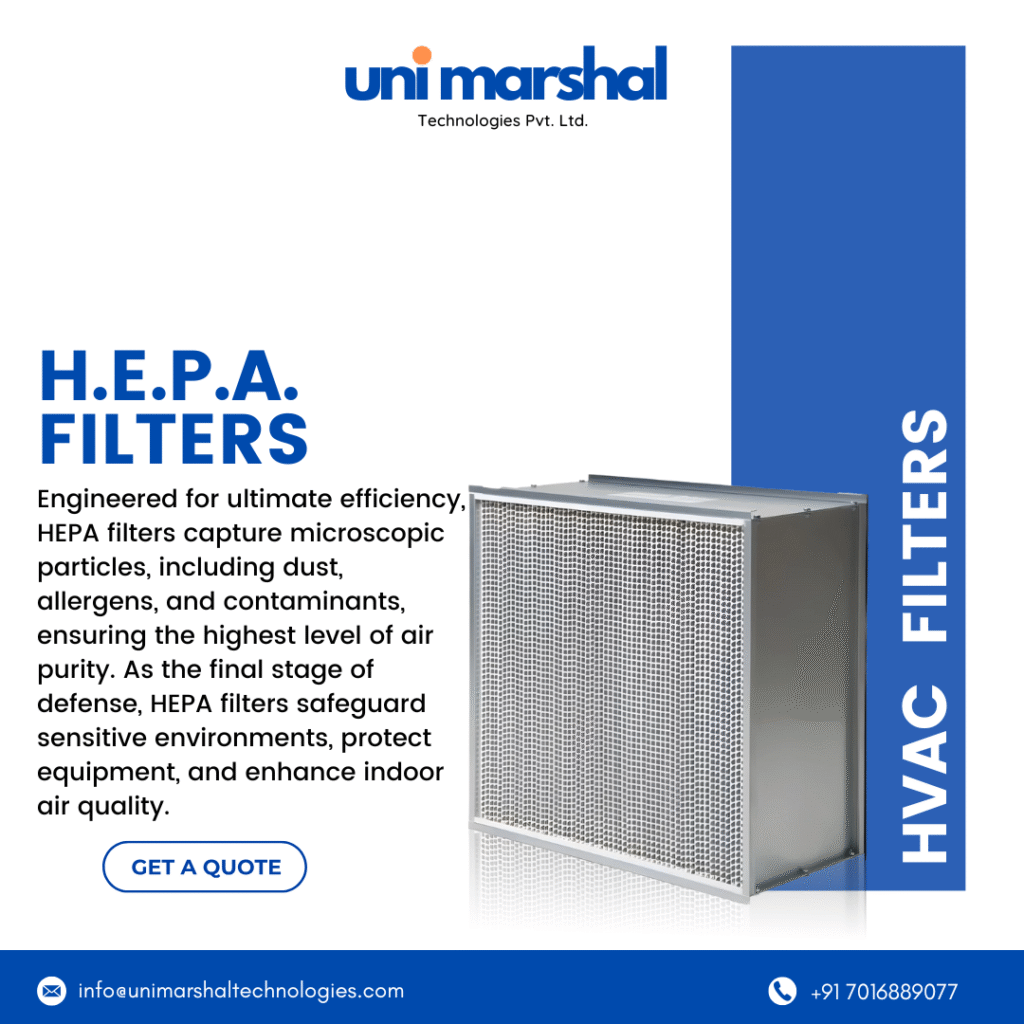
4. HEPA Box Type Filters
- Design: Rigid box-shaped filters with robust frames.
- Applications: Cleanrooms, laminar airflow units, and biosafety cabinets.
Box-type HEPA filters are durable and designed to withstand high airflow and pressure conditions.
5. HEPA Flange Type Filters
- Design: Equipped with flanges for easy installation and airtight sealing.
- Applications: Pharmaceutical and biotech facilities, electronics manufacturing, and laboratories.
Flange-type filters ensure zero leakage and are perfect for critical contamination control.
6. Mini-Pleat HEPA Filters
- Design: Compact with closely packed pleats for maximum surface area.
- Applications: Semiconductor manufacturing, aerospace, and precision laboratories.
Mini-pleat HEPA filters deliver high efficiency with lower pressure drop, making them energy efficient.
7. Washable / Reusable HEPA Filters
- Design: Can be cleaned and reused multiple times.
- Applications: Industrial dust collectors, automotive air systems.
While not as common in critical applications, washable HEPA filters reduce maintenance costs in industrial setups.
Export Market Perspective
With growing global emphasis on air quality and clean manufacturing environments, the demand for HEPA filters is rapidly increasing across industries. At Unimarshal Technologies Pvt. Ltd., we manufacture and export a wide range of HEPA filters including Panel, Box Type, Flange Type, and Mini-Pleat designs to markets in USA, UK, Germany, UAE, Singapore, and beyond. Our filters are built with international standards in mind, ensuring reliability and performance in diverse industrial applications.
Conclusion
Choosing the right type of HEPA filter is vital to maintaining air purity, equipment efficiency, and safety standards. Whether it’s a panel filter for HVAC systems or a box/flange filter for cleanrooms, HEPA technology is an indispensable part of modern industry.
At Unimarshal Technologies, we provide end-to-end solutions in air filtration, making us your trusted partner for industrial and export filtration needs.
1. What does HEPA stand for?
HEPA stands for High-Efficiency Particulate Air. These filters are designed to capture 99.97% of airborne particles as small as 0.3 microns, ensuring clean and safe air.
2. How many types of HEPA filters are there?
HEPA filters can be broadly categorized into Standard HEPA (H10–H12), True HEPA (H13–H14), Panel Type, Box Type, Flange Type, Mini-Pleat, and Washable HEPA filters. Each type is suitable for different applications, from residential use to high-critical industries like pharmaceuticals and aerospace
3. What is the difference between Standard HEPA and True HEPA?
Standard HEPA (H10–H12): 85–99.5% efficiency, ideal for residential and commercial use.
True HEPA (H13–H14): 99.95–99.995% efficiency, suitable for cleanrooms, hospitals, and critical industrial environments.
4. Which industries use HEPA filters the most?
HEPA filters are widely used in healthcare, pharmaceuticals, food & beverage, electronics, aerospace, semiconductor manufacturing, cleanrooms, laboratories, and industrial HVAC systems.
5. What is the lifespan of a HEPA filter?
The lifespan depends on the operating environment, airflow, and contamination levels. Typically, HEPA filters last 6–12 months in commercial use and up to 2–3 years in industrial setups with proper maintenance.